food philosophy

Sponsored Links
Wagashi Dialogues

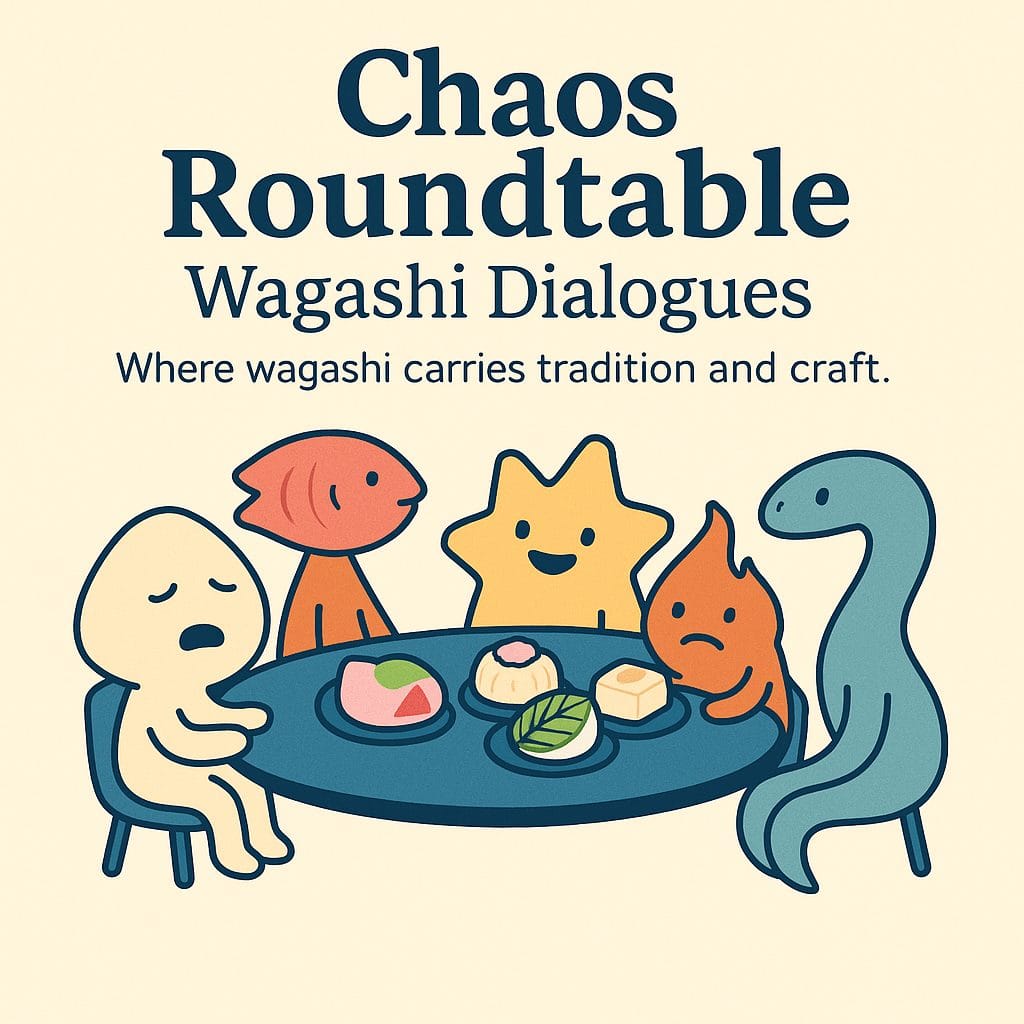
“Are sweets the soul of the tea room?” Chaos Roundtable: Wild

We asked, “What’s the most important part of the tea ceremony?”Someone said “the host.” Someone said “the timing.”And th...
Wagashi Dialogues

“Do you eat nerikiri, or does nerikiri eat you?” Chaos Roundtable: Wild

We thought we were just eating a sweet.But halfway through the bite, something looked back.🍙 Characters🍙 Mochi – The met...
Wagashi Dialogues

“A hundred cuts, one breath” Wagashi Dialogues

Before tea stirs the mind, the whisk stirs the bowl.But what stirs the whisk into being?This is a story of hands, bamboo...
Sponsored Links
Wagashi Dialogues

“A swirl that holds centuries” Wagashi Dialogues

The tea whisk doesn’t just stir matcha.It stirs air, attention, and generations of hands.In the quiet room of tea, even ...
Wagashi Dialogues

“Can a whisk hold a hundred years?” Chaos Roundtable: Wild

Someone asked, “Why does the tea whisk look so simple?”We laughed. Then we talked about bamboo, generations, and sweets ...
Wagashi Dialogues

What disappears faster—nerikiri or the season it represents? Chaos Roundtable: Wild

We tried to hold spring in our hands.But it melted. Or maybe we ate it. Either way, it’s gone now.🍙 Characters🍙 Mochi – ...
Chaos Roundtable

“Yokan doesn’t break—it holds.” Wagashi Dialogues

At first glance, yokan looks like a sweet that doesn’t try too hard. Smooth, quiet, restrained. But behind that surface ...
Wagashi Dialogues

“When yokan travels, it changes—why do sweets carry dialects?” Wagashi Dialogues

Yokan looks deceptively consistent—rectangular, muted, dignified. But across Japan, this sweet reveals subtle accents. F...
Wagashi Dialogues

“Yokan isn’t just dense—it’s historical memory in edible form.” Wagashi Dialogues

It sits heavy in your hand, like a relic. Yokan is more than a dessert—it’s a shape of time itself. Once offered to monk...
Wagashi Dialogues

“Is making Ohagi an act of tradition—or quiet precision only hands can teach?” Wagashi Dialogues

Ohagi looks simple—sweet rice, red bean paste, sometimes a dusting of kinako.But behind its soft surface lies a world of...
Sponsored Links