At first glance, yokan looks like a sweet that doesn’t try too hard. Smooth, quiet, restrained. But behind that surface is a discipline as rigid as it is elegant. From the delicate timing of heat to the firmness of its final shape, yokan is a sweet that doesn’t flow—it forms. And in that form, a tradition holds still.
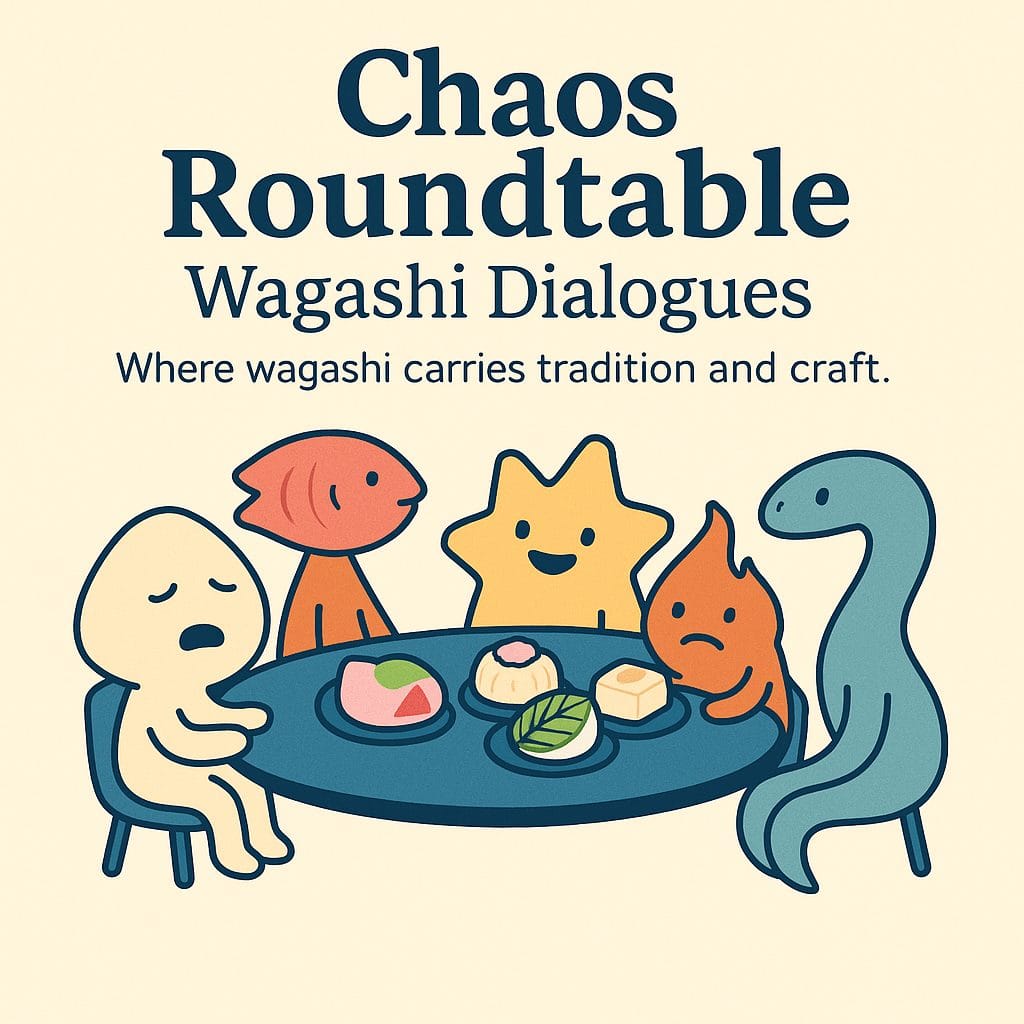
Characters in this Dialogue
🍙 Mochi – The wonderer who hears silence in sweets
🐟 Salmo – The craftsman-minded realist decoding heat and process
🌀 Eldon – The philosopher reading stillness as structure
💫 Milla – The feeler who listens to shine and softness
🔥 Blaze – The reformer exploring modern takes on tradition
🌸 Sakura – The sentimentalist moved by subtle forms of care
🐍 Thorne – The skeptic who questions reverence and resists nostalgia
【Section 1】Form is not a default
🍙 Mochi:
Yokan seems like the kind of sweet that’s just… there. Always the same. But maybe that sameness is carefully earned?
🐟 Salmo:
It is. The process is unforgiving. Too much stirring, the texture turns gritty. Too little heat, it won’t set. It’s not passive—it’s disciplined.
🔥 Blaze:
And it’s not about innovation, really. It’s about holding the line. Every shop has its own balance—how shiny, how firm, how deep the flavor.
💫 Milla:
I love how it doesn’t beg for your attention. It just waits, perfectly still, until you’re ready.
🐍 Thorne:
So it’s the Zen monk of sweets. Just sitting there, not melting, judging your chaos.
🌀 Eldon:
That stillness is precisely what invites attention. Yokan is sculpted quietness. That requires effort.
🌸 Sakura:
And maybe that effort is what makes it comforting. A sweet that says, “I’m here. Unchanged.”
【Section 2】The science of still
🐟 Salmo:
Getting the boil right is crucial. You can’t measure just temperature—you have to read the surface tension, the scent, the way the bubbles move.
🍙 Mochi:
So it’s like reading weather in a pot.
🔥 Blaze:
Some artisans even say they can hear when it’s ready. Not see—hear.
💫 Milla:
That’s wild. Like the yokan whispers back, “Now.”
🌀 Eldon:
Mastery isn’t just repetition. It’s responsive control. The sweet teaches you how to make it, over years.
【Section 3】How shine becomes message
🌸 Sakura:
I once visited a shop where the yokan shimmered like polished stone. The owner said it had to reflect light without showing your face.
🐟 Salmo:
That’s intentional. The surface tells you about the inner consistency. Dull means rushed. Over-shiny means overcooked.
🔥 Blaze:
We’re used to gloss meaning luxury. But in yokan, it means care. It’s a signal, not decoration.
💫 Milla:
That line down the center of the slice, like a horizon—it always feels peaceful.
🍙 Mochi:
I never thought a rectangle could say, “Stay a while.”
🐍 Thorne:
Yokan doesn’t flatter you. It expects you to come closer on your own.
🌀 Eldon:
Yes. It’s not a sweet that seduces. It allows proximity, then offers permanence.
【Section 4】Can tradition be quiet and alive?
🔥 Blaze:
Modern versions now play with textures—layers, add-ins, yuzu peels. But they still keep the yokan structure.
🐟 Salmo:
Because the moment you lose that integrity, it becomes jelly. And jelly doesn’t hold memory.
💫 Milla:
Even when I try a new version, I check for the center firmness. Like asking, “Are you still yourself?”
🐍 Thorne:
Maybe tradition isn’t about resisting change. It’s about surviving translation.
🌸 Sakura:
And yokan translates well because it never shouted to begin with.
🍙 Mochi:
So it’s not a dessert that evolves—it waits for us to evolve toward it.
🌀 Eldon:
Perhaps yokan isn’t tradition frozen in sugar, but sugar tuned into ritual. What holds may not speak—but it remembers.
🌀 Summary
In this roundtable, yokan is explored not as a dessert but as a discipline—a form that holds sweetness through stillness. The team dives into the precise techniques behind its making, from heat management and surface gloss to the philosophical act of containment. Each voice reveals how yokan balances impermanence and durability, asking not for attention but for recognition. Whether as ritual, memory, or quiet resistance, yokan emerges as a sweet that does not melt—it endures.