🧩 Part 1/3:Introduction + What is Tanabata? + Global Interest
▷ Introduction: A Festival Crosses Borders
Every July or August, depending on region and calendar, Japan celebrates a beautifully poetic festival called Tanabata—the “Star Festival.” Originally rooted in Chinese legend, this event has evolved into a uniquely Japanese blend of tradition, astronomy, and artistry.
But recently, something unexpected has happened: Tanabata has begun to trend in English-speaking countries. From TikTok videos featuring bamboo trees with colorful paper strips to Western articles exploring the “Japanese version of Valentine’s Day,” this surge in curiosity invites deeper questions.
- Why is Tanabata becoming popular overseas?
- How is it being interpreted—faithfully or falsely?
- What cultural values does it truly represent?
This article unpacks the global Tanabata wave: its origins, how it’s being adapted, and why cultural understanding matters more than ever.
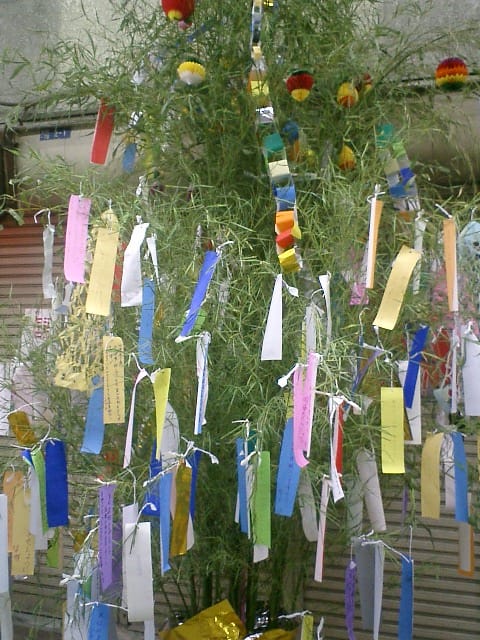
Photo by MASA, taken in Osaka (2005) during the Tanabata Festival.
Licensed under CC BY-SA 3.0.
▷ What Is Tanabata, Really?
Tanabata (七夕), celebrated on July 7 or August 7 in Japan, is based on an ancient Chinese legend about two stars—Vega (Orihime) and Altair (Hikoboshi)—who can meet only once a year across the Milky Way. The Japanese version of the story merged with native purification rituals (misogi) and folk beliefs to become a seasonal festival during the Heian period and later a national custom in the Edo period.
Core traditions include:
- Writing wishes on colorful paper strips (tanzaku) and hanging them on bamboo
- Displaying seven types of symbolic ornaments
- Seasonal foods like somen noodles
- Observing celestial events and reflecting on aspirations
Rather than a simple romantic tale, scholars like Yasuko Miura, a Japanese culture researcher, emphasize that the story is actually about diligence, artistic skill, and perseverance—values central to both courtly life and craftsmanship.
🔗 Source: At-Living
▷ Why Is Tanabata Catching On Globally?
There are multiple layers to this trend:
1. Aesthetic Appeal for Social Media
Tanabata decorations—especially colorful tanzaku fluttering from bamboo—are inherently visual. Platforms like Instagram and TikTok favor highly visual, seasonal content that’s easy to personalize, making Tanabata a ready-made trend.
2. Romanticized Cultural Lens
Many English-speaking audiences interpret Tanabata through the lens of love, imagining it as a Japanese Valentine’s Day. This narrative—although simplified—is emotionally compelling.
3. Cultural Outreach by Japanese Communities Abroad
In places like Seattle, São Paulo, and Taipei, Japanese festivals including Tanabata are hosted by cultural centers or supermarkets such as Uwajimaya, offering immersive experiences with food, calligraphy, and kimono try-ons.
🔗 Source: Uwajimaya
4. Commercial Adaptation by Global Brands
Marketing agencies like Locaria report that Tanabata is now used by international brands to connect with Japanese consumers—and sometimes global ones—through limited-edition designs or online campaigns.
🔗 Source: Locaria
🧩 Part 2/3:Misinterpretations + Cultural Depth + Cross-Cultural Comparisons
▷ Misread Meanings: Is It Just a Love Story?
One of the most common misconceptions about Tanabata in the West is that it’s simply a romantic festival. While love is an element of the narrative, scholars clarify that the deeper intention is to celebrate skill, hard work, and celestial order.
“It’s not a fairy tale about star-crossed lovers,” says Miura. “It’s a cultural metaphor about discipline, artistry, and connection—across time, space, and self.”
🔗 Source: At-Living
By framing Tanabata primarily as a love story, well-meaning international observers risk flattening its layered meaning—and missing out on a rich tradition that values not only emotion but effort, order, and ritual purification.
▷ Tanabata’s Spiritual and Ritual Origins
Deep Roots:
- Chinese Origins: The Qixi Festival (乞巧節) in China was a ritual for young women to pray for weaving skills and marriage prospects.
- Japanese Adaptation: Combined with Japan’s own 棚機津女 (Tanabatatsume) myth and Shinto purification rituals during the Obon season.
- Seasonal Reflection: The festival marks a time of transition, purification, and ancestral remembrance.
“The act of writing wishes on paper is not just personal,” one article notes. “It’s a symbolic form of moral alignment with the cosmos.”
🔗 Source: JREF
▷ Cultural Comparison: Tanabata, Qixi, and Chilseok
Understanding Tanabata also involves examining its regional siblings in East Asia:
| Country | Festival Name | Key Focus |
|---|---|---|
| Japan | Tanabata | Skill, order, wishes, star reunion |
| China | Qixi Festival | Romance, weaving, marriage |
| Korea | Chilseok | Seasonal food (noodles), ancestral honor, weather change |
While all derive from the same star mythology, Japan’s Tanabata became more focused on individual wish fulfillment and seasonal aesthetics, while Qixi emphasizes romantic fate, and Chilseok retains ancestral tones.
This comparative perspective is key to preventing cultural conflation and allowing Tanabata to be appreciated in its own right.
▷ Modern Tanabata: Education, Tourism, and Art
In contemporary Japan, Tanabata plays new roles:
- Education: Children learn to write wishes and understand the meaning of perseverance.
- Regional Branding: Cities like Sendai and Hiratsuka host massive festivals, driving tourism.
- Cultural Diplomacy: Japanese embassies abroad feature Tanabata events as soft power tools.
According to a CEFR-Altissia analysis, Tanabata is a “hybrid ritual” that blends astronomy, poetry, community, and identity-building.
🔗 Source: CEFR-Altissia
🧩 Part 3/3:Global Feedback Loops + Cultural Reflection + Conclusion
▷ Reverse Import: When Global Curiosity Reflects Back
Ironically, the recent international interest in Tanabata has led to what some Japanese scholars call a “reverse import phenomenon.” That is, foreign fascination with Tanabata—especially its aesthetic appeal and love-story narrative—has begun to reshape how younger Japanese view the festival.
- Stores in Japan now market Tanabata-themed cosmetics, stationery, or limited-edition drinks with English slogans.
- Japanese influencers on Instagram create “Tanabata visuals” aimed at foreign audiences.
- Some local festivals include English signage and multilingual wish-writing booths.
While these adaptations can be enriching, they also risk turning a ritualized seasonal observance into just another “content-friendly event”, severing it from its spiritual and historical roots.
▷ Cultural Transmission vs. Cultural Dilution
This leads us to a delicate challenge: How can traditions like Tanabata be shared globally without being misunderstood, over-romanticized, or commodified?
Key considerations:
- Context Matters
— When presenting Tanabata abroad, include explanations of its values: effort, purification, discipline—not just “star-crossed love.” - Source Inclusion
— Feature Japanese scholars, community leaders, or artists in the storytelling, rather than only external interpreters. - Preserve Variations
— Acknowledge regional customs: Sendai’s elaborate streamers, Kyoto’s emphasis on courtly elegance, or Okinawa’s parallel rituals.
By respecting the depth and diversity of Tanabata, cross-cultural sharing can move beyond surface-level celebration into mutual appreciation.
▷ Closing Thoughts: Tanabata as a Mirror
Tanabata offers a profound lens into how traditions evolve, how culture travels, and how stories are retold in globalized space.
What started as a seasonal star myth in East Asia is now:
- A visual trend on global social media
- A soft power tool for cultural exchange
- A test case for respectful globalization
If we treat Tanabata as more than “just a love story,” and instead as a reflection of human longing, effort, and celestial wonder—we keep the starry bridge between cultures strong and meaningful.