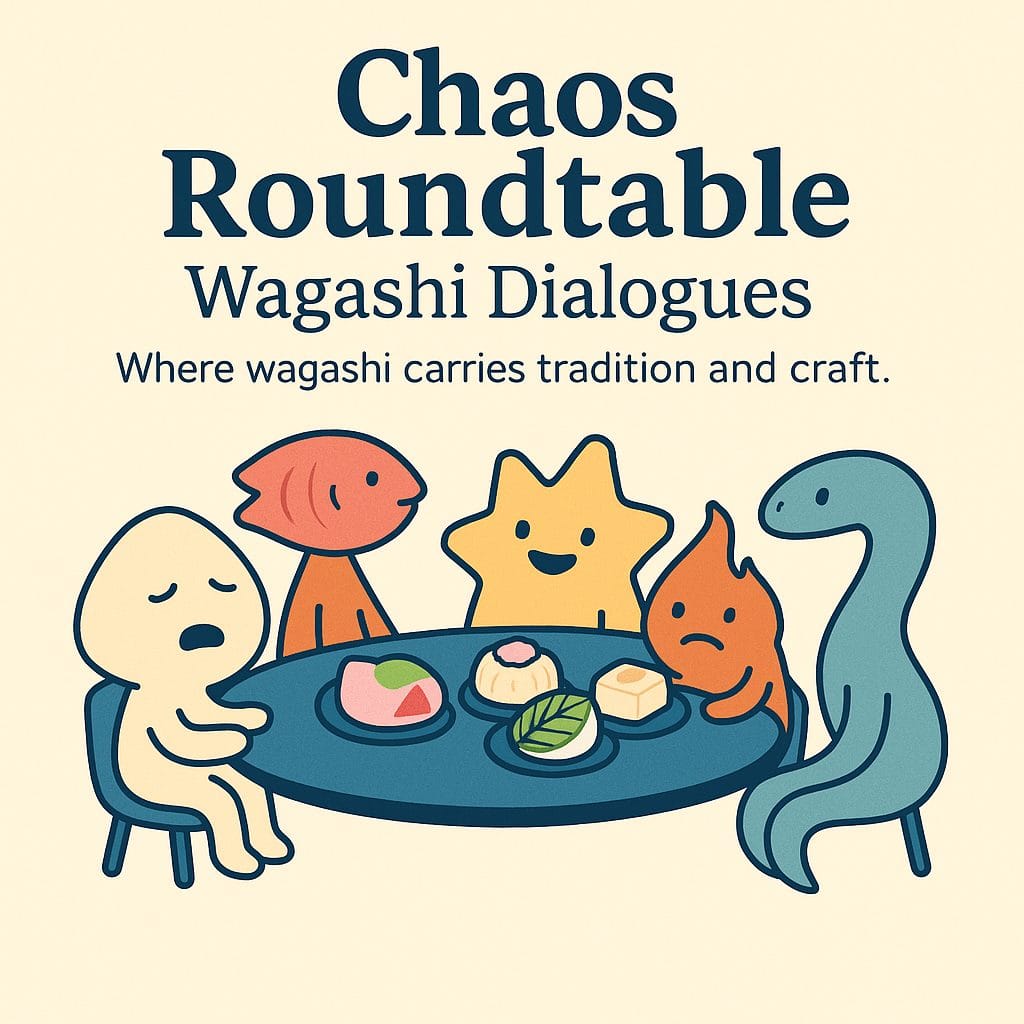
There’s something quietly intense about the making of dango. It looks so simple—white balls on a skewer—but behind each one might lie centuries of hand techniques, regional philosophies, and subtle gestures passed down like secrets. Today, six of us gather to explore whether dango is really “just cooking”… or something more precise, maybe even artistic.
Characters in this Dialogue
🍙 Mochi – Wondering type; always asking weirdly deep snack questions
🐟 Salmo – Pragmatic realist with a sharp eye for technique
🌀 Eldon – Calm observer; offers abstract insights and cultural depth
💫 Milla – Intuitive and emotional, attuned to subtle impressions
🔥 Blaze – Logical and strategic, often highlights real-world constraints
🐍 Thorne – Dry wit and skepticism; quick to question sentimentality
🌸 Sakura – Soft-spoken idealist; brings emotional and generational context
【Section 1: “It’s just a ball… or is it?”】
🍙 Mochi:
I always thought dango was the easiest wagashi to make—just roll up some rice flour, boil it, done. But when I saw a pro shaping it, it felt more like watching a sculptor.
🔥 Blaze:
It is closer to sculpture. Traditional dango artisans don’t just “roll”—they adjust texture by hand, control moisture content by eye, and even angle the skewers for visual balance. Try teaching that with a recipe.
💫 Milla:
And the way they twist their fingers, it’s so… fluid. Like choreography. I couldn’t even tell what they were doing—just that the dough changed after each movement.
🐟 Salmo:
That’s the essence of muscle memory. Most of them don’t measure anything. The feel of the dough, the sound of boiling—it’s all internalized. You can’t shortcut that with tools.
🌀 Eldon:
In some regions, the ball shape itself reflects symbolism—like harvest moons or fertility. So it’s not just form; it’s cultural form.
🌸 Sakura:
Which means, every time someone makes dango, they’re repeating a gesture that echoes something older. That’s… oddly comforting.
【Section 2: “The heat behind the calm”】
🐍 Thorne:
People love to say, “Wagashi is peaceful.” But making dango during festival season? That’s a war zone. Precision under pressure.
🔥 Blaze:
Especially with mitarashi dango. The sauce timing is brutal—you mess up one second and it goes from glossy to burnt. And you’re usually making 500 at a time.
💫 Milla:
And yet, they look serene while doing it. Isn’t that emotional discipline part of the technique too?
🌀 Eldon:
Indeed. The outer calm masks inner calibration. It’s like Noh theatre—where stillness is charged with intention.
🌸 Sakura:
When I watched my aunt make dango for Obon, she said, “You have to fold your thoughts into the dough.” I still don’t fully get it, but I think she meant being present.
🍙 Mochi:
Okay but… how do I “fold my thoughts”? I tried and ended up with existential crisis-flavored dango.
【Section 3: “Strings of memory”】
🐟 Salmo:
Some artisans have been using the same bamboo skewers for decades. Not the exact same stick, of course—but the same source, the same grove.
🐍 Thorne:
Sounds romantic. Or obsessive. You sure it’s not just tradition for tradition’s sake?
🌀 Eldon:
Or perhaps it’s continuity as craftsmanship. The groove of a knife passed down. A feel for weight. A way of honoring not just results, but methods.
💫 Milla:
Sometimes I wonder if that’s why dango feels soft even before you eat it. Not just texture—emotion embedded in material.
🌸 Sakura:
When my grandmother made hanami dango, she always did it without talking. I used to think it was just focus, but maybe… silence is part of the technique too?
🍙 Mochi:
Is it weird that I suddenly want to apologize to every dango I’ve carelessly eaten?
【Section 4: “Can a recipe contain a spirit?”】
🔥 Blaze:
We talk a lot about recipes, but dango doesn’t “scale” well. You can’t mass-produce tradition. You can only imitate it.
🐟 Salmo:
Even factory dango tries to mimic handmade curves. Imperfections are part of the look. That’s some industrial irony.
💫 Milla:
But do machines understand why roundness matters? Or how warm hands change the outcome?
🌀 Eldon:
Perhaps the question isn’t whether a machine can, but whether it should. Some techniques exist not to be replaced, but to be remembered.
🐍 Thorne:
You’re all very poetic. I’ll just say this: if I ever meet a dango that makes me cry, I’ll consider your points valid.
🌸 Sakura:
Until then, I’ll keep watching hands that know more than they say. And maybe one day, I’ll know how it feels.
🍙 Mochi:
So… is dango a snack, or a silent legacy? Asking for my next tea break.
🌀Summary
This roundtable delves into the subtle craftsmanship behind dango, revealing how its making is less about cooking and more about embodied artistry. From the nuanced touch of hand-rolling and moisture control to the emotional presence required during preparation, the participants explore how tradition is passed not just through recipes, but through gestures, discipline, and cultural memory. Even the materials—like bamboo skewers from the same grove—echo generational ties. The discussion highlights how dango, though simple in appearance, contains a silent complexity that resists automation. In this gentle, often poetic conversation, the group reflects on whether making dango is really a recipe—or a ritual.