In Japan, dango isn’t just a sweet—it’s a signal of local identity, changing from region to region like dialects. But how different can one simple dumpling really be?
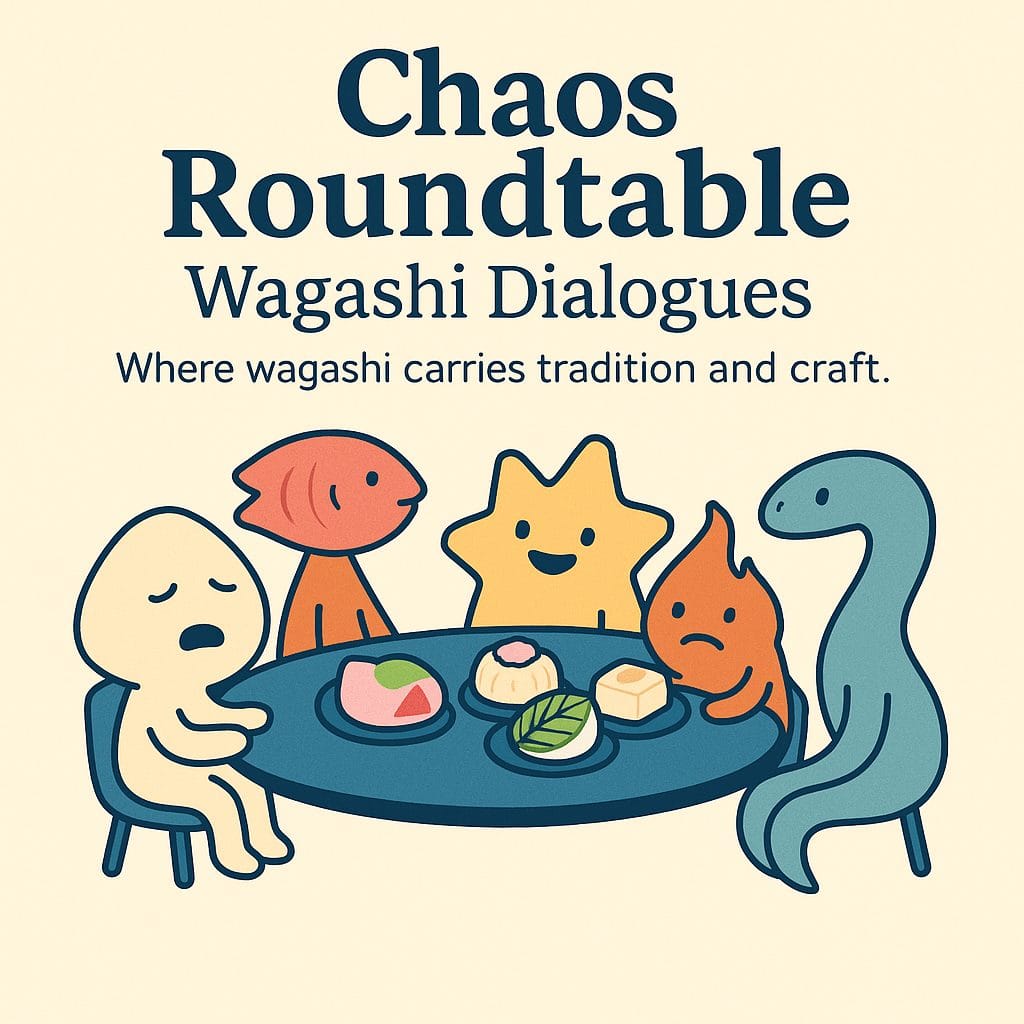
Characters in this Dialogue
- 🍙 Mochi: Intuitive and playful instigator, always tossing in fresh ideas
- 🐟 Salmo: Grounded and analytical, quick to point out logical gaps
- 💫 Milla: Sensitive and spontaneous, driven by emotion and vibe
- 🐍 Thorne: Sarcastic observer, digs into nuance and contradiction
- 🌀 Eldon: Thoughtful synthesizer, abstracts and contextualizes patterns
- 🔥 Blaze: Strategic and entrepreneurial, looks for broader frameworks
🍙Mochi:
You know, I used to think all dango looked the same—three or four little balls on a skewer. But then I stumbled on one that looked more like a flat disc. And another one was literally covered in ash. What’s going on?
🐟Salmo:
It’s not just “dango” as one thing. There’s kibi-dango, kusa-dango, gohei-mochi style—some are steamed, some are grilled, some are pounded rice. The materials and shapes shift based on region, and that reflects local climate and crops.
🌀Eldon:
Regional variation in dango is like a culinary dialect—each region speaks “sweet” in its own accent. Where there’s more wheat, you get flour-based dumplings; where there’s abundant rice, it’s mochiko. The grammar of ingredients changes with geography.
💫Milla:
I once had dango in Nagano that was so smoky I thought it was a campfire snack! But somehow, it fit the mountains. Like it was meant to be eaten outdoors, under trees.
🔥Blaze:
Even the sauce changes. You’ve got sweet soy in Kanto, strong miso in Gifu, and red bean paste in Hokkaido. It’s like everyone decided what “comfort” tastes like in their region—and made a dango to match.
🐍Thorne:
Of course, the regionalism isn’t always romantic. Some versions survived simply because of limited access to sugar or refrigeration. Ash-covered dango wasn’t aesthetic—it was preservation.
🌸Sakura:
Still, it’s kind of beautiful that something as humble as dango carries so many echoes of home. Even if we can’t see the map, we can taste it.
[Section 2: Shapes as Memories]
🍙Mochi:
Is it weird that I associate round dango with festivals, but flat ones with… being scolded? I think my grandma used to flatten them when she was mad at me.
💫Milla:
Wait, same! My aunt in Niigata made these super firm ones like little shields—chewy and serious. They felt like her personality, somehow.
🌀Eldon:
Interesting. The shape of a dango becomes not just a food memory, but a personality imprint. Culture isn’t abstract—it’s edible.
🐟Salmo:
There’s even seasonal shapes. Hanami dango in spring is three-colored for cherry blossoms, but some areas switch the order of the colors. Local preferences override national “standards.”
🔥Blaze:
And then there’s mitarashi dango—looks standard, right? But in Kyoto it’s different from Tokyo’s. One’s more caramelized, the other more soy-forward. A minor shift in recipe changes the entire vibe.
🐍Thorne:
That “minor shift” is often unconscious. It’s not deliberate branding—it’s just inertia. You make it the way your parents did.
🌸Sakura:
But maybe that’s what makes it precious. It’s inherited routine. And every variation is a memory that survived.
[Section 3: Dango as Identity Markers]
💫Milla:
It’s funny, I thought of dango as just “a snack,” but now I’m realizing it’s like a family crest made of rice.
🐟Salmo:
And people defend it like one too. I’ve seen arguments online about the “right” way to skewer them.
🍙Mochi:
That’s the thing—when food becomes identity, even skewers become battlegrounds. Dango wars!
🔥Blaze:
Well, there’s a logic to it. Regional pride often finds its stage in the mundane. And the mundane sticks harder than slogans.
🌀Eldon:
Perhaps dango offers a subtle lens into how localism persists—through taste, texture, and repetition. Not through declarations.
🐍Thorne:
And ironically, the more similar things become nationwide, the more we clutch at micro-differences. “This one is steamed, not boiled.”
🌸Sakura:
Which only proves that even small things—like a dumpling’s shape—can carry heavy meaning when they’re made with care.
[Section 4: Can a Dango Be Political?]
🍙Mochi:
Okay, this might be a stretch, but… if local dango disappears, is that like cultural erosion?
🐟Salmo:
Not a stretch. It’s happening already—some traditional shops can’t keep up with production costs. Convenience store dango is standardized.
💫Milla:
That makes me sad. I liked not knowing what I’d get next when I ordered dango in a new place. Now it’s always the same three balls.
🔥Blaze:
It’s a matter of scalability. Uniformity sells better. But it also flattens meaning.
🌀Eldon:
Which brings us to a paradox: food that once reflected local diversity now risks becoming a symbol of its loss.
🐍Thorne:
And what remains is nostalgia sold in pre-packed form. A simulation of local flavor.
🌸Sakura:
But maybe, if we remember the stories, we can still taste the difference. Even in a plastic box.
Summary
From chewy skewers in Kansai to Hanami-colored balls in Tokyo, this roundtable explores how dango isn’t just a snack—it’s a symbol of regional pride and seasonal memory. Through contrasting examples like mitarashi and gohei dango, the team delves into how taste, form, and even temperature reflect local traditions. Disagreements emerge around authenticity, nostalgia, and standardization, leading to surprising realizations about how personal memory can override geography.