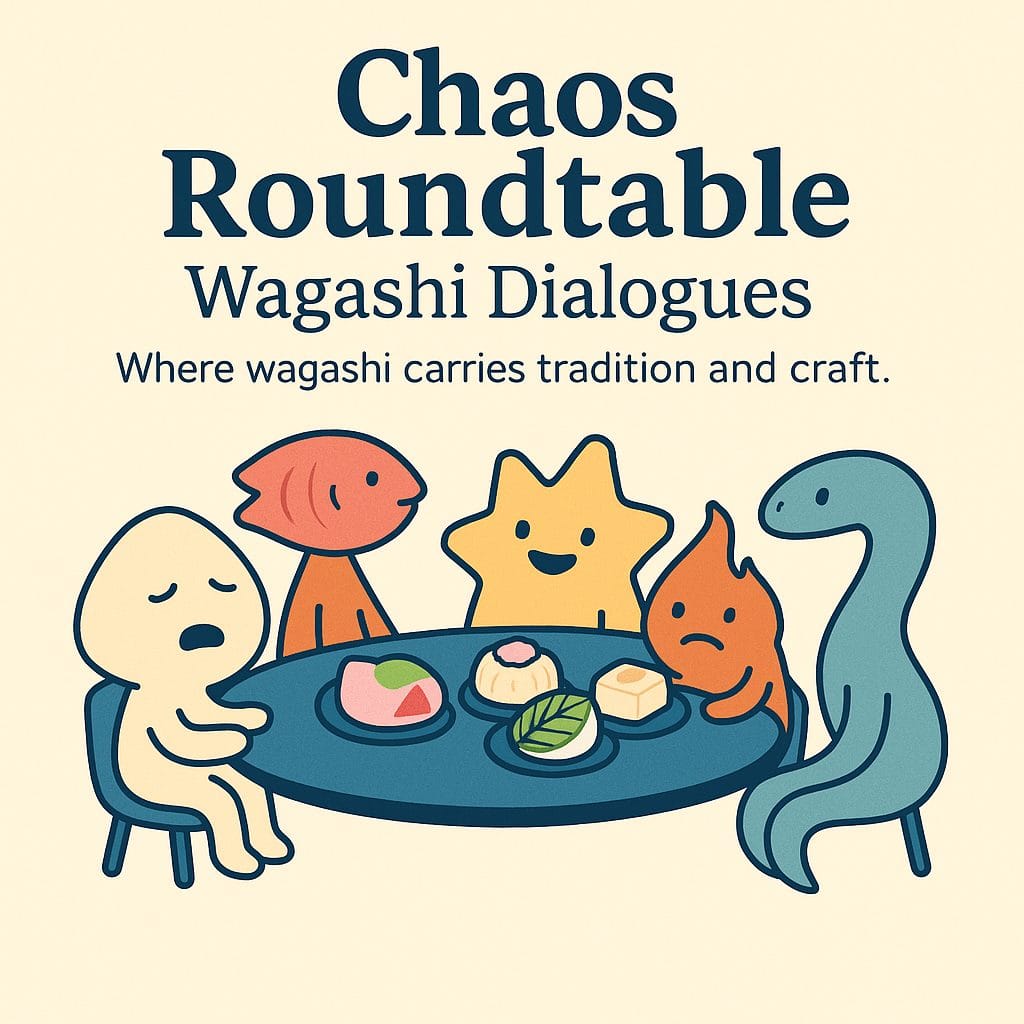
Soft, round, neatly skewered—dango is the kind of sweet that feels casual, even humble.
But it shows up in some of Japan’s most cherished seasonal moments.
Cherry blossoms? There’s dango. Full moon? Dango again.
Why this sweet? Why always three? Why on a stick?
Today, our roundtable digs into what dango really carries beneath its chewy surface.
Characters in this Dialogue
🍙 Mochi – The curious voice who questions the ordinary and finds hidden rhythms
🐟 Salmo – The realist connecting food to function, history, and place
🌀 Eldon – The philosopher who interprets arrangement and silence as ritual
💫 Milla – The feeler who senses emotion through color, shape, and texture
🌸 Sakura – The sentimentalist who brings in memories of seasonal traditions
🔥 Blaze – The revivalist who sees modern echoes of ceremonial sweets
🐍 Thorne – The skeptic who challenges meaning but secretly listens
【Section 1】Why is dango always “in formation”?
🍙 Mochi:
I get that dango is cute and tasty, but why is it always on a stick? Who decided sweets need formation?
🐟 Salmo:
Skewering was originally practical—easy to grill, serve, and carry. But it also made them visually clean, like edible punctuation.
💫 Milla:
Three in a row feels intentional. Like they’re holding hands or waiting for something together.
🌸 Sakura:
And there’s a rhythm to it. Green for spring, white for the body, pink for bloom. A gentle poem on a stick.
🐍 Thorne:
So we’re eating poetry now. What’s next—haiku cupcakes?
🌀 Eldon:
Arrangement is often how rituals begin. When sweets line up, they’re not just food. They become gesture.
【Section 2】When the moon watches dango
🌸 Sakura:
In my family, tsukimi dango was a quiet ritual. No party—just silence, moonlight, and a plate of white spheres.
💫 Milla:
It feels like the sweet is looking back at you. Like, “We’re both reflecting something.”
🐟 Salmo:
Moon-viewing dango is shaped like the full moon for a reason. It’s symmetry meant to invite pause.
🍙 Mochi:
And you stack them into a pyramid! Like sweet little stargazers.
🌀 Eldon:
That stacking mimics offering. It’s not a snack—it’s a moment of verticality. Earth to moon, via flour and silence.
【Section 3】Dango as sweet solidarity
🍙 Mochi:
What’s wild is how dango always seems to be eaten together. You never sneak a dango alone.
🐍 Thorne:
Unless you’re shame-eating at midnight, but sure, go on.
🌸 Sakura:
Hanami dango isn’t just for spring—it’s for sharing the spring. You pass the stick, not just the sweetness.
💫 Milla:
Maybe that’s why they’re firm and chewy. They slow you down, keep you in the moment.
🔥 Blaze:
And yet they don’t melt, don’t crumble. Dango is dependable joy.
🌀 Eldon:
The chew is communal time. It makes people sync up—bite by bite, season by season.
🐟 Salmo:
So even if the setting changes—temple, picnic, shop—the message stays: “Let’s pause together.”
【Section 4】What dango remembers
🔥 Blaze:
Even konbini dango feels like it’s carrying something older. Like, “I used to be ceremonial. Don’t forget.”
💫 Milla:
And even if you don’t know the story, you feel it. The stick gives it shape. The trio gives it rhythm.
🐍 Thorne:
I still think it’s just rice balls on a skewer, but now I’m suspicious of their silence.
🌸 Sakura:
Maybe that silence is the point. Dango doesn’t explain—it invites.
🍙 Mochi:
So dango isn’t just sticky rice—it’s sticky memory.
🌀 Eldon:
Perhaps sweets like dango don’t hold flavor—they hold time. Quiet, offered, and meant to be shared.
🌀 Summary
This roundtable explores dango not as a simple skewered sweet, but as a layered cultural gesture. From its three-part symmetry to its presence in moon-viewing rituals and spring picnics, dango emerges as a sweet that organizes silence, seasons, and social time. The group traces how its shape invites gathering, how its chew slows moments, and how its quiet presence bridges memory and offering. Even the most casual stick of dango carries an unspoken ritual—one bite at a time.