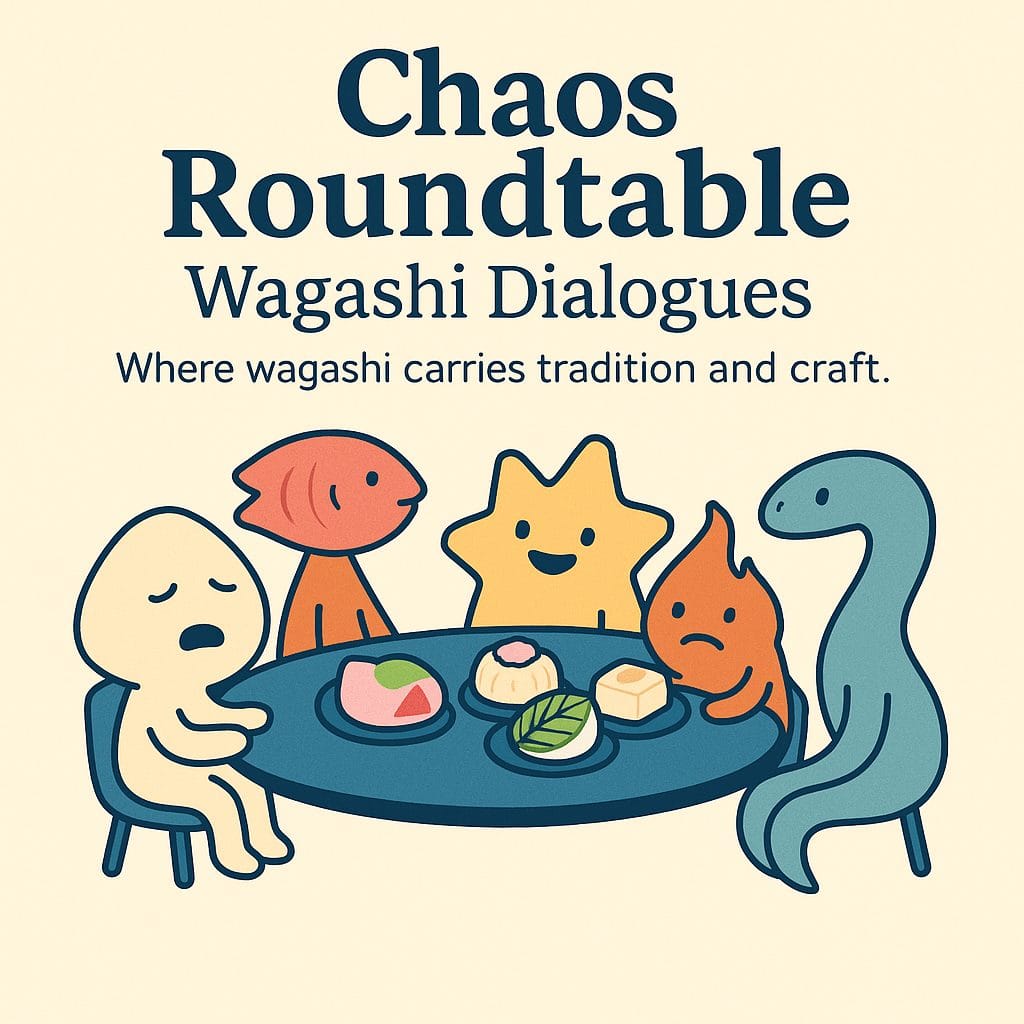
It may look like just another soft wagashi, but kurumi mochi carries centuries of tradition between its folds. Behind the velvety texture and the subtle walnut aroma lies a story of labor, precision, and devotion—sometimes passed down through generations. Today, our roundtable dives into the understated beauty of its craftsmanship.
Characters in this Dialogue
🍙 Mochi – The idea-sparker who sees softness as a mystery
🐟 Salmo – The realist who honors precision and tools
🌀 Eldon – The philosopher observing the ritual behind technique
💫 Milla – The feeler who connects through texture and nostalgia
🔥 Blaze – The innovator bridging tradition and revival
🐍 Thorne – The skeptic who pokes at romanticized craftsmanship
【Section 1】The softness that hides precision
🍙 Mochi:
Isn’t it strange? Kurumi mochi looks so soft and mellow, but the process behind it feels… intense. Like, you need force to make it gentle?
🐟 Salmo:
That’s actually quite accurate. The pounding technique—especially with a wooden mallet—isn’t just about strength. It’s rhythm. Uniform pressure, controlled timing. Precision creates softness.
💫 Milla:
Ooh, so it’s like a love letter written with a hammer. That’s kind of poetic and scary.
🔥 Blaze:
There’s also the preparation of the walnuts. Roasting, peeling, grinding into a paste—it’s all incredibly delicate. One wrong move, and the flavor goes bitter.
🐍 Thorne:
Let’s not romanticize everything. There’s also centuries of back pain involved.
🌀 Eldon:
Yet, that pain becomes part of the ritual. Traditional sweets like this often honor imperfection—slight inconsistencies show the human touch. Machine-made mochi lacks that subtle rebellion.
【Section 2】Why walnut?
🍙 Mochi:
But why walnuts in the first place? Japan isn’t exactly famous for them.
🐟 Salmo:
Historically, regions like Shinshu and Tohoku had access to wild walnuts. They were foraged, not cultivated. This mochi evolved out of resourcefulness.
🔥 Blaze:
It also served a preservation purpose. Walnut paste has natural oils—it helped retain moisture in the mochi. A kind of ancient technology.
💫 Milla:
So… even taste was a side effect of survival? That’s oddly beautiful.
🐍 Thorne:
Or accidental. “We have these nuts, what now?”—classic human innovation.
🌀 Eldon:
Still, the pairing holds emotional resonance. The contrast between the mochi’s softness and the nut’s slight bitterness mimics the human palate’s craving for balance.
【Section 3】Tools, traditions, and calloused hands
🐟 Salmo:
You know what’s underrated? The tools. The usu (mortar) and kine (mallet) are almost spiritual objects in this process.
🔥 Blaze:
Especially in family-run wagashi shops. The same mortar passed down for decades, stained by every seasonal batch. It’s like history embedded in wood.
🍙 Mochi:
And imagine being trained to “feel” the mochi’s readiness through your hands, not thermometers or timers.
💫 Milla:
Whoa, like a sixth sense! Your hands remember softness.
🐍 Thorne:
Until your hands remember arthritis too.
🌀 Eldon:
Indeed, the bodily memory becomes the archive. In traditions like these, skill isn’t just taught—it’s absorbed. Often without words.
【Section 4】Craft vs convenience
🍙 Mochi:
So… why don’t we see handmade kurumi mochi more often? It’s mostly mass-produced now.
🐟 Salmo:
Time, cost, inconsistency. Industrial production favors predictability. Handcraft does not.
🔥 Blaze:
But there’s a growing movement to revive regional crafts. Some wagashi makers are reintroducing kurumi mochi using old methods—partly for tourism, partly for pride.
💫 Milla:
Even if I didn’t grow up with it, I feel like I’m missing something when I eat the factory-made one.
🐍 Thorne:
That “missing” is what makes nostalgia profitable.
🌀 Eldon:
Or perhaps it’s a longing for touch—something our digital age can’t replicate. Kurumi mochi, in its handmade form, is less a product than a gesture.
🌀 Summary
In this roundtable, the team unwraps the hidden depth of kurumi mochi—where softness is born not of ease, but of effort. From the rhythm of pounding mochi with wooden tools to the delicate handling of walnuts, the discussion reveals how traditional techniques carry a quiet defiance against mechanized uniformity. They explore the historical necessity that led to walnut-based sweets, the transmission of skill through bodily memory, and the emotional residue left in handmade texture. Between reverence and sarcasm, each voice traces how this humble sweet becomes a silent archive of craftsmanship.