Kurumi-mochi has the soft chew of rice cake, the richness of sweet sauce—and a name that doesn’t always match its ingredients.
Sometimes it contains walnuts. Sometimes it doesn’t.
And somehow, it remains beloved by regions that rarely talk about it.
So what exactly is Kurumi-mochi? A dessert? A dialect? A memory?
Let’s bite in.
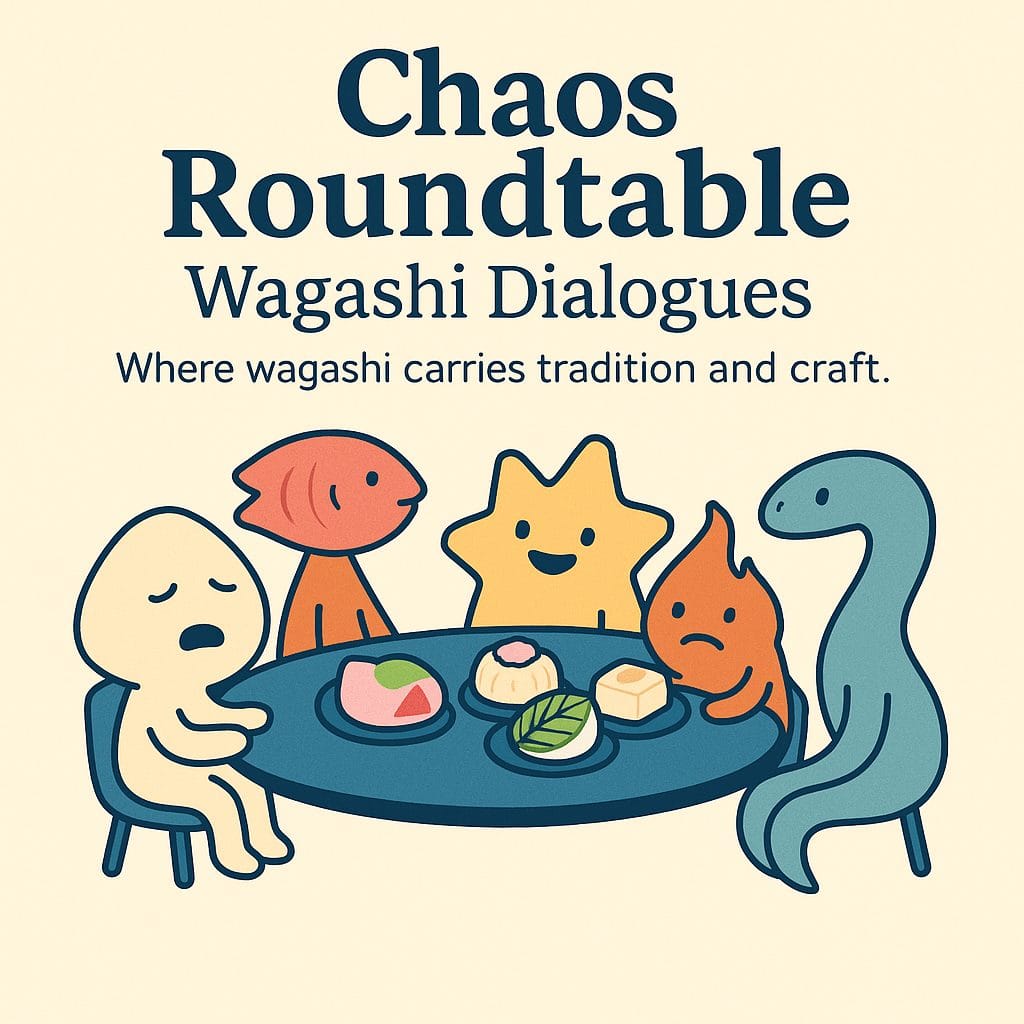
🍡 Characters in this Dialogue
🍙 Mochi — Free-spirited instigator. Twists conversations with playful questions.
🐟 Salmo — Logical realist. Brings structure, facts, and clarity.
🌀 Eldon — Philosophical observer. Sees patterns and keeps the meta calm.
💫 Milla — Emotional and intuitive. Leads with warmth and empathy.
🐍 Thorne — Sharp and sarcastic. Cuts through sentiment with wit.
【1】What’s in a name?
🍙 Mochi:
Okay, wait—Kurumi-mochi doesn’t always have… actual walnuts?
🐟 Salmo:
Right. In Osaka, it’s a green mochi in sweet sauce—no walnuts involved. But in Tohoku, it’s crushed walnut paste on top.
💫 Milla:
That’s like naming a cat “Dog” and pretending it makes sense.
🌀 Eldon:
Or like language: sometimes names are fossils from meanings that faded.
🐍 Thorne:
So “Kurumi-mochi” is a lie passed down with love.
🍙 Mochi:
Or a delicious miscommunication.
【2】Stuck in the region
🐟 Salmo:
Kurumi-mochi is almost unknown outside its hometowns. You don’t see it in tourist gift shops.
🌀 Eldon:
That gives it weight. Not being exported makes it feel sacred to its soil.
💫 Milla:
Exactly! It’s like a flavor that never packed its bags.
🍙 Mochi:
So when someone makes it for you, it feels like you’re being let in on a local secret.
🐍 Thorne:
Or they just had leftover rice and wanted to impress you with sauce.
🐟 Salmo:
Even the sauce changes. Some use miso, some soy, some sweet walnut paste. Each recipe is territorial.
【3】Flavor and memory
💫 Milla:
My grandfather used to say, “The sweeter the walnut, the shorter the winter.”
I never understood what it meant—but I remember how it tasted.
🌀 Eldon:
Sometimes food isn’t explained. It’s felt. Then it disappears.
🍙 Mochi:
Kurumi-mochi feels like something people don’t write down—they just remember how to make it.
🐟 Salmo:
And when they leave the town, the recipe stays.
🐍 Thorne:
So we’re eating memories that refused to emigrate.
【4】Why it matters
🌀 Eldon:
Kurumi-mochi is a reminder that not all sweets want to be famous.
💫 Milla:
It’s enough to be loved by one town, one house, one person.
🐟 Salmo:
And still, it survives. Quietly.
🐍 Thorne:
Until someone tries to brand it as “Walnut Bliss™” and ruins everything.
🍙 Mochi:
So maybe Kurumi-mochi isn’t just mochi with sauce.
Maybe it’s home, folded in starch and silence.
🌀 Summary
Kurumi-mochi appears simple, but its name and nature shift from region to region—sometimes containing walnuts, sometimes not. In this roundtable, the team explores its quiet cultural role as a sweet that rarely leaves its hometown, and how its variations reflect the unspoken language of food and memory. Through gentle humor and reflective thought, Kurumi-mochi emerges not as a national dessert, but as a local secret held in sauce, tradition, and silence.