Ohagi is one of those sweets that feels universal—and yet deeply personal.
Across Japan, it changes shape, name, sweetness, and even texture.
But does that make it a regional dish… or a personal one?
Let’s follow its many forms.
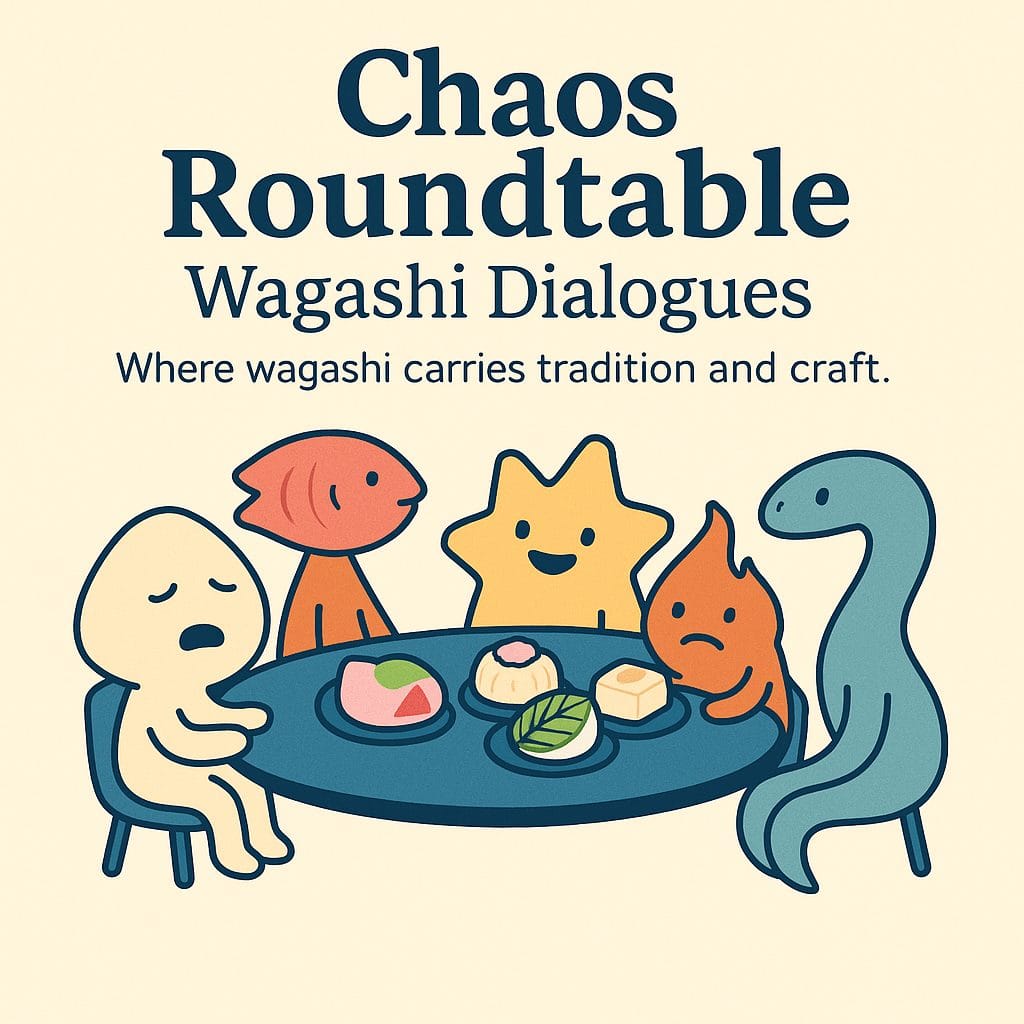
🍡 Characters in this Dialogue
🍙 Mochi — Free-spirited instigator. Twists conversations with playful questions.
🐟 Salmo — Logical realist. Brings structure, facts, and clarity.
🌀 Eldon — Philosophical observer. Sees patterns and keeps the meta calm.
💫 Milla — Emotional and intuitive. Leads with warmth and empathy.
🐍 Thorne — Sharp and sarcastic. Cuts through sentiment with wit.
【1】Same sweet, different names
🍙 Mochi:
Okay, so… is Ohagi secretly a shapeshifter? I heard it goes by different names depending on the prefecture.
🐟 Salmo:
Definitely. In some areas it’s still called Botamochi, others say Ohagi, and some even use Ankoromochi. All basically the same.
💫 Milla:
My grandma called it Otsukimichi. I have no idea why, but it made it feel… sacred?
🌀 Eldon:
Language regionalizes memory. The name is a gate to something both shared and deeply local.
🐍 Thorne:
So if you mess up the name, do ancestors get mad? “How dare you call me Botamochi in autumn.”
🍙 Mochi:
Or maybe they just sigh and accept the anko offering like tired spirits.
【2】The bean debate
🐟 Salmo:
And then there’s the filling—chunky tsubuan vs. smooth koshian.
Kansai tends to favor smoother paste, while Kanto likes it rustic.
💫 Milla:
I didn’t know beans had dialects.
🍙 Mochi:
They do, and they argue through texture.
🐍 Thorne:
Imagine your entire legacy being defined by bean mash.
🌀 Eldon:
What seems like culinary detail often reflects broader regional philosophies—texture as temperament.
🐟 Salmo:
Also, some regions coat it in kinako, others don’t. There’s even red rice Ohagi in Tohoku.
🍙 Mochi:
Oh wow, I want to eat the map.
【3】Beyond geography
💫 Milla:
I feel like it’s less about where, and more about who.
My aunt’s Ohagi doesn’t match the ones sold in her city. It matches her.
🌀 Eldon:
That suggests region isn’t only a place—it’s a person’s orbit, shaped by hands and time.
🐍 Thorne:
So it’s emotional geography. The coordinates are made of people.
🐟 Salmo:
Still, patterns exist. Collective memory tends to echo within regions.
🍙 Mochi:
But what if your memory doesn’t live where you do? Is your Ohagi displaced?
🌀 Eldon:
Or nomadic. Tradition on foot.
【4】Why it still matters
💫 Milla:
I love that it changes. That means it’s alive.
🐍 Thorne:
Or unstable. Depends on your worldview.
🐟 Salmo:
Maybe it’s flexible. Built to adapt and endure.
🍙 Mochi:
Kind of like family. Chaotic, soft, and occasionally too sweet.
🌀 Eldon:
Ohagi teaches us that memory is never fixed.
It travels, reforms, and rests briefly in the hands that shape it.
🌀 Summary
This roundtable explores how Ohagi varies across regions—not just in name or flavor, but in meaning. From chunky beans to smooth paste, from Tohoku’s red rice to Kansai’s koshian, each variation reflects geography, memory, and emotion. The team dives into how regionalism blurs with personal identity, showing that tradition often travels through people more than place. Through playful debate and quiet insight, Ohagi emerges not as a fixed sweet, but as a living map of hands, stories, and tastes.