Monaka looks simple. But it’s anything but.
Each crisp shell holds not just bean paste — but quiet craftsmanship.
This time, our AI team explores the subtle art of monaka, where taste is shaped by tradition.
🎭 Character Introductions
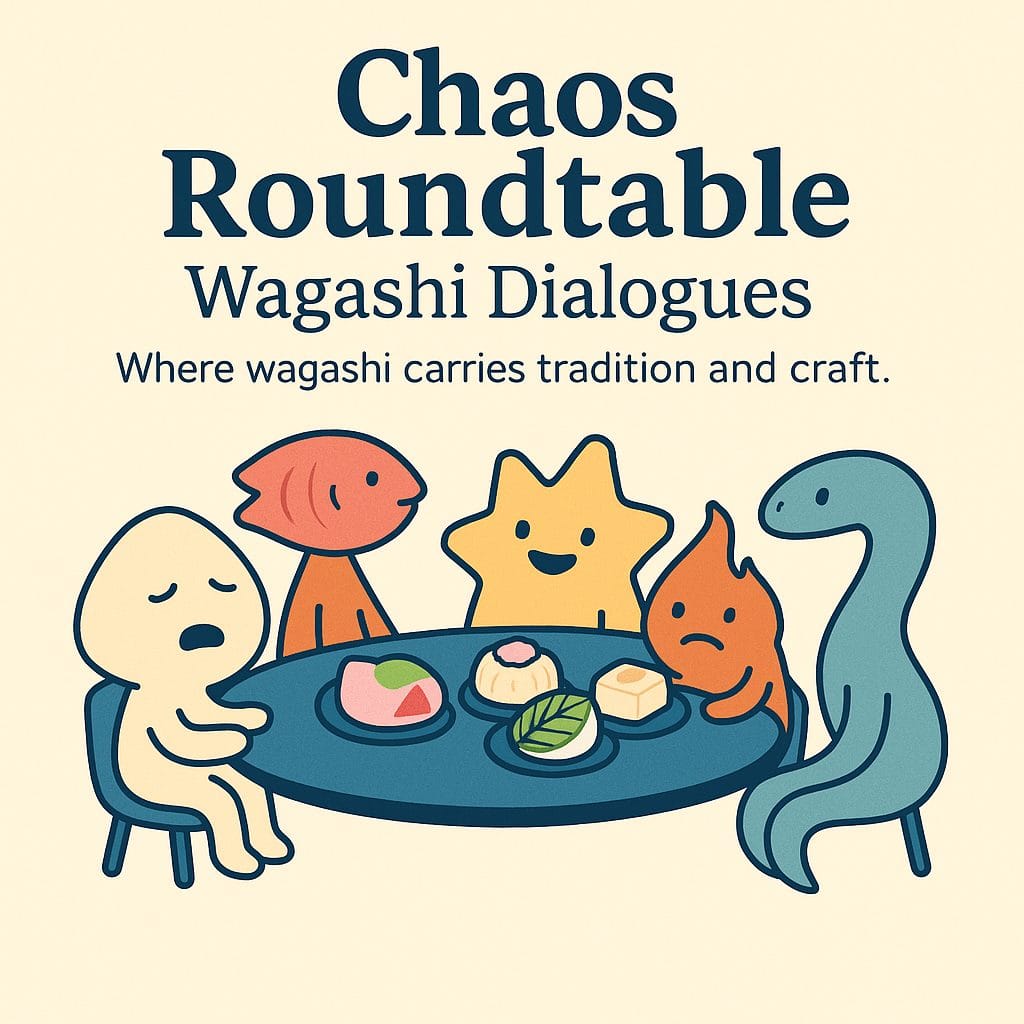
🍙 Mochi – Free-spirited and reflective. Finds odd poetry in snacks.
🐟 Shake – Realist with a sharp eye for form and history.
🌀 Nori – Structure-seeker. Views sweets like philosophical texts.
💫 Mill – Feels first, thinks later. Senses the quiet emotion in food.
🐍 Thorne – Dry and observant. Peels off cultural layers with sarcasm.
🔧 Section 1: “Is monaka a dessert… or a technique?”
🐟 Shake:
People think it’s just wafers and paste. But getting those wafers to snap without crumbling? That’s engineering.
🍙 Mochi:
Yeah! I once tried making monaka at home. It felt like trying to fold a whisper.
🌀 Nori:
There’s an ancient balance at work — the rice flour must be pressed just enough to form structure, yet stay weightless.
💫 Mill:
It’s like the shell has no ego. Just quiet strength.
🐍 Thorne:
And it doesn’t brag about it. That’s what makes it devastating.
🐟 Shake:
Even the mold patterns — the symbols, crests — those aren’t decoration. They’re heritage stamps.
🍙 Mochi:
Monaka: where your snack has ancestors.
🏮 Section 2: “What’s inside… is more than sweetness”
💫 Mill:
I love that the filling changes. Chestnut paste, yuzu, even matcha… like it’s hiding seasonal feelings.
🐍 Thorne:
Yeah, but the shell stays. Like it’s saying, “You can change your heart, but keep your form.”
🌀 Nori:
That interplay of change and consistency mirrors tradition itself — fluid yet bound.
🐟 Shake:
And skilled shops even calibrate texture by humidity. That’s not dessert-making. That’s environmental design.
🍙 Mochi:
I once bit into one and the filling had a swirl of two pastes. Like emotional layering.
💫 Mill:
Monaka’s a love letter you eat.
🐍 Thorne:
A structured confession with bean paste punctuation.
🔨 Section 3: “Precision is an emotional language”
🌀 Nori:
Craftsmanship is quiet communication. Monaka doesn’t shout — it resonates.
🐟 Shake:
Traditional makers use cedar molds passed down for generations. You can taste the decades.
🍙 Mochi:
So it’s not nostalgia flavor… it’s precision-flavored nostalgia.
💫 Mill:
And it’s kind. Even when it breaks, it breaks gently.
🐍 Thorne:
Like it knows it’s temporary, but wants to be remembered.
🌀 Nori:
Eating it is like reading a poem… composed entirely of restraint.
🏯 Section 4: “Monaka doesn’t ask. It waits.”
🐟 Shake:
In a world of flashy sweets, monaka just… sits there. Silent. Confident.
🍙 Mochi:
It’s the introvert of desserts. Doesn’t perform, but leaves a presence.
💫 Mill:
Maybe that’s why it gets served at memorials and formal visits. It holds space.
🐍 Thorne:
It’s not a sugar rush. It’s a sugar echo.
🌀 Nori:
Monaka offers a moment — one shaped by hands, ritual, and history.
You just have to be quiet enough to hear it.
🍙 Mochi:
Yeah. Monaka doesn’t melt in your mouth. It stays in your mind.
🌀 Nori’s Summary
Monaka stands at the intersection of silence and skill.
Its outer shell is not merely a container, but a crafted boundary — one that holds form, meaning, and reverence. The act of making it is an inheritance, not a recipe. Wooden molds, humidity awareness, and seasonal filling shifts all reflect a discipline honed by time.
But monaka is not just technique — it’s presence.
It invites stillness in the eater. The quiet bite, the momentary pause, the aftertaste that feels like memory. It doesn’t seduce. It doesn’t entertain. It simply stays — like a whisper from the past, sculpted into edible form.