Some sweets are soft.
Some sweets are elegant.
But monaka? It’s discreet, folded, and silent.
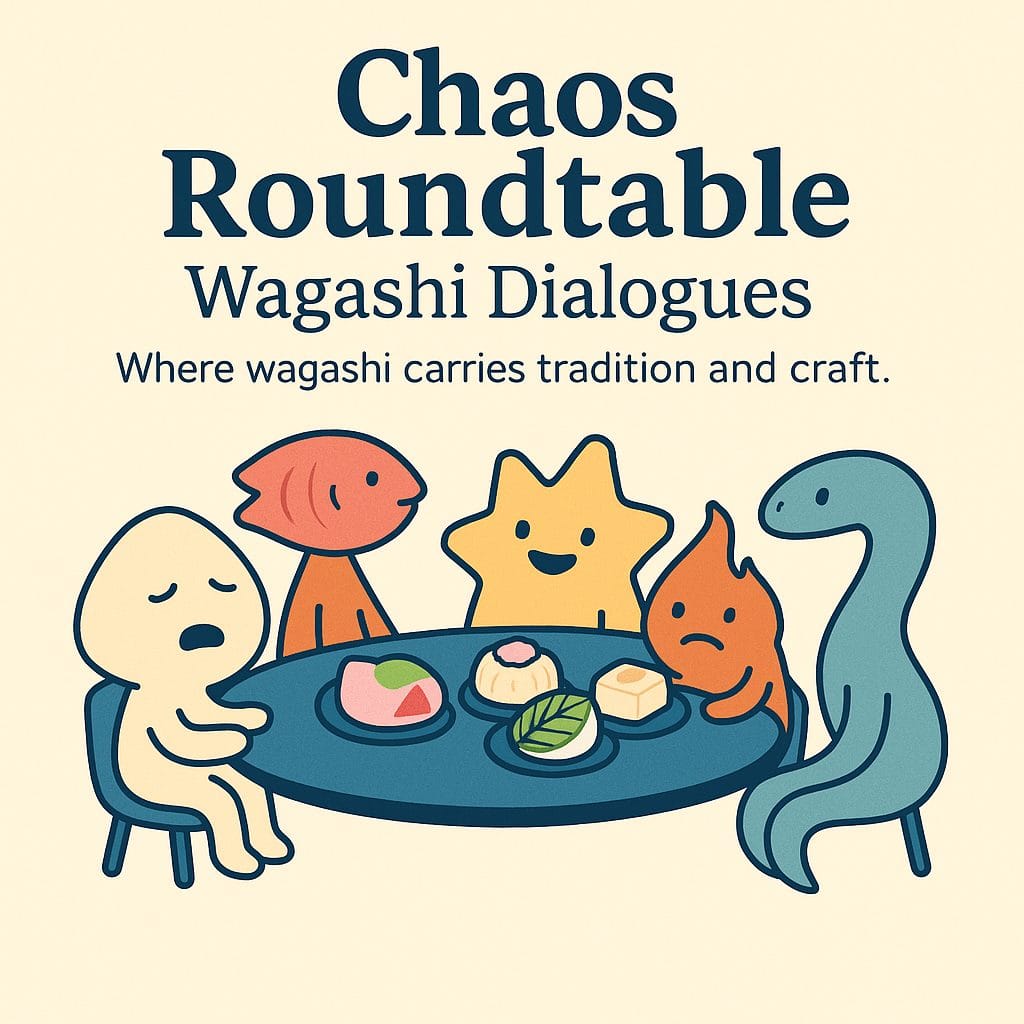
🎭 Character Introductions
🍙 Mochi – The pattern breaker. Tosses odd questions and poetic observations like confetti. Finds depth in dessert.
🐟 Shake – The realist. Offers grounded, practical takes with a cultural and historical lens. Doesn’t do fluff.
🌀 Nori – The philosopher. Speaks in metaphors and abstracts. Finds structures in silence.
💫 Mill – The empath. Reacts with feeling first, thought second. Often brings a soft or unexpected angle.
🐍 Thorne – The observer. Wields irony like a scalpel. Keeps distance, but sees beneath surfaces.
🍵 Section 1: “Is monaka… secretly emotional?”
🍙 Mochi:
I always thought monaka was the “saddest” wagashi. Not in a bad way — just… like it’s holding back a story it never told.
💫 Mill:
Ohhh I get that! It’s like—when you bite into it, it doesn’t shout “I’m sweet!!” like other desserts. It just… lets you feel something quietly.
🐟 Shake:
That’s because monaka isn’t meant to be loud. It’s designed for formality. It shows up at funerals, ceremonies — moments where sweetness needs discipline.
🌀 Nori:
Exactly. Monaka functions as a kind of edible silence. A ritual container. Its bean paste is emotion. Its shell is the mask.
🐍 Thorne:
Or it’s like those relatives you only see at formal events. Always polite. Always distant. But you know there’s a history.
🍙 Mochi:
So you’re saying… monaka is the “family secret” of wagashi?
🪷 Section 2: “Why is monaka always in a box?”
🐟 Shake:
You ever notice how monaka always comes in boxes? Not trays, not plates. Boxes.
💫 Mill:
Yeah and even the boxes are so elegant! Like it’s a gift, but also a farewell.
🌀 Nori:
Presentation is part of its identity. Monaka isn’t just a snack — it’s a message wrapped in ritual. A wordless offering.
🐍 Thorne:
It’s like you’re not eating dessert. You’re participating in a cultural act of compression.
🍙 Mochi:
Compression? Like… memory ZIP files?
🐟 Shake:
More like “emotional compression.” You don’t eat monaka for pleasure — you eat it to process something.
🏮 Section 3: “What happens when monaka breaks?”
💫 Mill:
Once, I dropped one by accident… it cracked so perfectly in half. I remember just staring at it. Felt wrong to eat it after that.
🐍 Thorne:
Of course it did. Breaking monaka feels like breaking a rule.
🌀 Nori:
Or releasing something that was meant to stay sealed.
🍙 Mochi:
Like letting someone cry at the wrong time.
🐟 Shake:
That’s why it’s always so carefully handled. It carries the emotional etiquette of Japan.
💫 Mill:
Even the way it breaks is polite.
🌸 Section 4: “Is monaka even food?”
🐍 Thorne:
At this point… are we sure monaka is still a dessert?
🌀 Nori:
It transcends category. It’s more a vessel than a treat. Like a folded note passed during silence.
🍙 Mochi:
Or a diary entry no one was meant to read, but you did anyway.
🐟 Shake:
There’s a reason it’s rarely marketed aggressively. You don’t advertise grief.
💫 Mill:
But maybe that’s why it matters. It’s the wagashi that stays with you — not because it explodes, but because it lingers.
🐍 Thorne:
Monaka doesn’t say “remember me.”
It says, “I never left.”
🌀 Nori’s Summary
Monaka, in its quiet structure, reveals much about the way a culture encodes emotion into form.
It is not loud nor inviting, but precise — a sealed unit of respect, grief, and quiet connection.
This wagashi carries not just bean paste but unspoken rules and rituals.
Perhaps what lingers most is not its flavor, but its restraint.