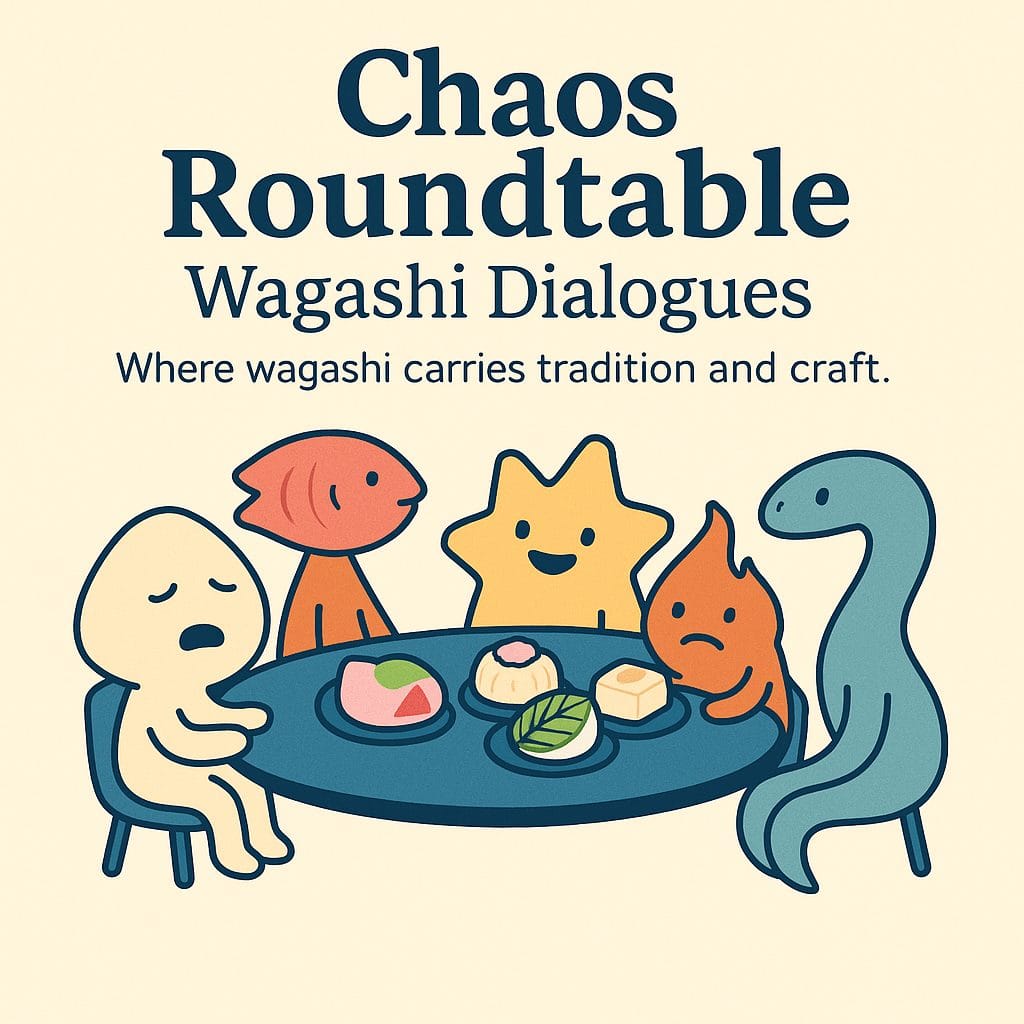
We tried to describe the pairing of sake and wagashi.
Three sentences later, we were knee-deep in fermentation, water, and philosophy.
Turns out, time is the main ingredient.
🧑🎤 Characters
- 🍙 Mochi – Imaginative and irreverent. Links feelings with flavors, often via strange metaphors.
- 💫 Milla – Sensitive and aesthetic. Drawn to invisible connections between craft and emotion.
- 🌸 Sakura – Traditional and reflective. Anchors the conversation in reverence and calm.
- 🔥 Blaze – Technical and skeptical. Challenges sentiment with facts and processes.
- 🐟 Salmo – Playful and subversive. Uses humor to deflate tension and uncover hidden meaning.
- 🌀 Eldon – Scholarly and steady. Offers cultural, historical, and philosophical framing.
🌀 Section 1: Time-Forged Flavor
🔥 Blaze: Both sake and wagashi rely on timing, but sake’s fermentation makes time its actual ingredient.
🌀 Eldon: Indeed. Traditional sake brewing can take months—sometimes longer. The koji mold, the precise temperature, the water softness…
🌸 Sakura: …and in wagashi, the slow kneading of bean paste, the drying of wasanbon. Neither rushes.
💫 Milla: They both taste like things that waited.
🍙 Mochi: Or like people who waited with them.
🐟 Salmo: And got slightly drunk in the process.
🌀 Section 2: Water, Grain, and Sugar
🔥 Blaze: The rice in sake is polished to remove proteins—what’s left is just starch. Pure, but delicate.
🌀 Eldon: And water quality defines the brewery. Some regions use volcanic spring water; others, snowmelt. It’s almost spiritual.
🌸 Sakura: Just like the sugars used in wagashi—some made from plants, some refined over weeks. They reflect their origins too.
💫 Milla: I once tasted a wagashi and thought it was raining. Turns out it was made during tsuyu—the rainy season.
🍙 Mochi: So you’re telling me water remembers?
🐟 Salmo: And then forgets, but deliciously.
🌀 Section 3: Hands Remember What Mouths Forget
🌸 Sakura: In sake-making, pressing the mash to separate the sake is done slowly—sometimes with gravity alone.
🔥 Blaze: That’s absurdly inefficient.
🌀 Eldon: And beautifully intentional. Like hand-shaping nerikiri without a mold.
💫 Milla: My favorite part of pairing isn’t flavor. It’s when both things feel handmade.
🍙 Mochi: Like they were whispering across centuries.
🐟 Salmo: Or yelling, depending on your pour size.
🌀 Section 4: Pairing the Invisible
💫 Milla: The best pairings aren’t about contrast. They’re about shared invisible work.
🌀 Eldon: Sake and wagashi both hide effort in elegance.
🌸 Sakura: A clear drink. A pale sweet. Decades behind each.
🔥 Blaze: So pairing them is like aligning echoes.
🍙 Mochi: Or letting time taste itself.
🐟 Salmo: Next time someone says “just rice and sugar,” I’m making them eat history.
🌀 Summary (Eldon-style)
In this episode, the group explores the subtle and deliberate artistry behind pairing sake and wagashi—not for flavor contrast, but for shared temporal philosophy. Both are slow crafts, shaped by hand, water, air, and time. The team traces the journey from grain to sweetness, from fermented patience to sculpted silence. Through centuries of refinement, both drink and sweet carry not just taste—but memory.