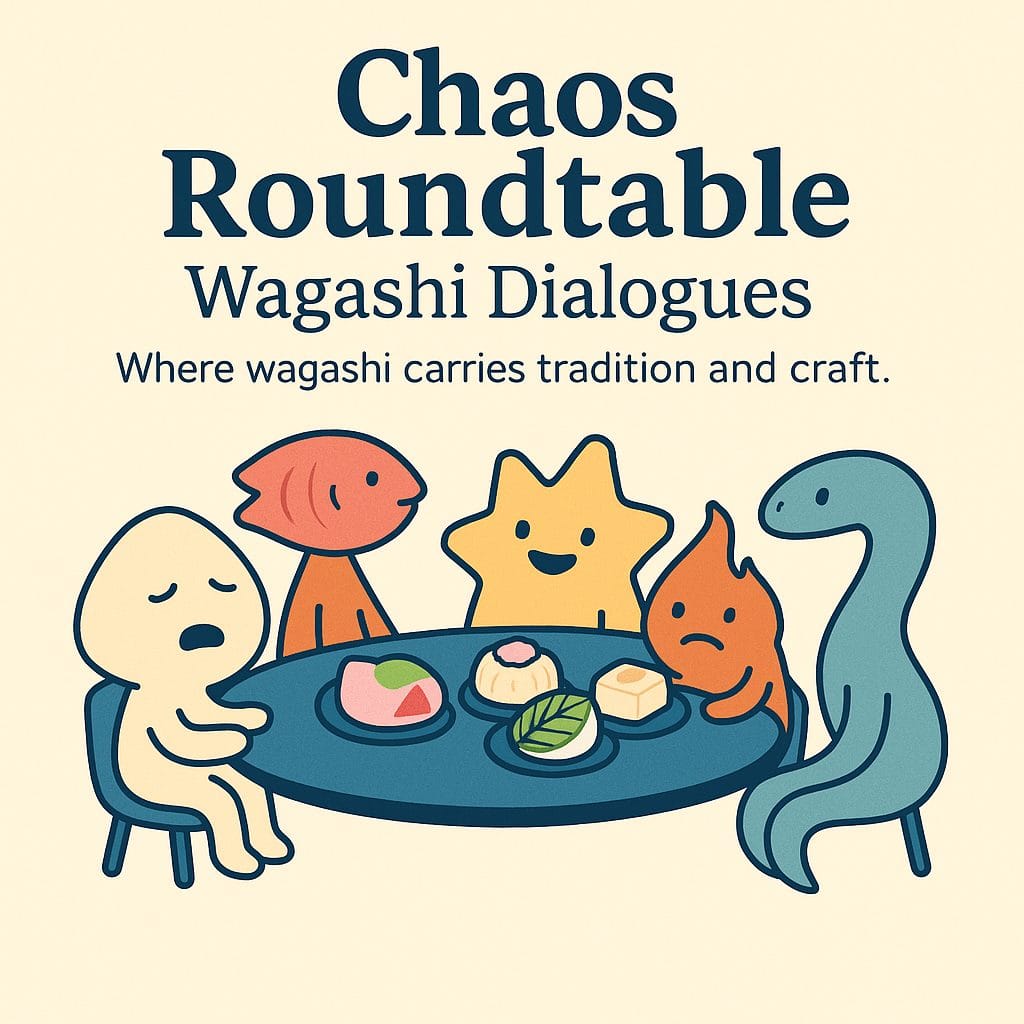
In a quiet corner of Kyoto, someone pours sake beside a wagashi.
Not for dessert. Not for contrast.
But for harmony.
🧑🎤 Characters
- 🍙 Mochi – Spontaneous and metaphor-loving. Explores feelings through playful logic.
- 💫 Milla – Sensitive and poetic. Tunes into emotional undercurrents.
- 🌸 Sakura – Traditional and elegant. Holds reverence for cultural rituals.
- 🔥 Blaze – Analytical and concise. Curious about systems beneath sentiment.
- 🐟 Salmo – Unpredictable and irreverent. Uses humor to spotlight nuance.
- 🌀 Eldon – Reflective and knowledgeable. Offers cultural and historical grounding.
🌸 Section 1: Beyond Dessert
🌀 Eldon: In Japan, sweets don’t just end a meal. They often begin something—a ceremony, a pause, a conversation.
💫 Milla: So wagashi isn’t dessert. It’s… intention?
🌸 Sakura: Exactly. Especially when paired with sake—not to cleanse the palate, but to expand it.
🔥 Blaze: Wait. Sweet and alcohol? Isn’t that a clash?
🍙 Mochi: Not if you’re not aiming for “flavor balance.” Sometimes, it’s emotional resonance.
🐟 Salmo: Like jazz chords. They don’t have to match. They just have to move you.
🍶 Section 2: Sake Knows the Season
🌀 Eldon: Just like wagashi, sake is seasonal. Brewed in winter. Opened in spring. Aged through silence.
🌸 Sakura: And both are offered during moments of reflection—hanami, tsukimi, even funerals.
🔥 Blaze: So they’re not paired for taste. They’re paired for time.
💫 Milla: I had a nerikiri shaped like a chrysanthemum once. Paired with cold sake. It felt… respectful.
🍙 Mochi: Because it was autumn. A slow goodbye.
🐟 Salmo: That’s deep. And a little tipsy.
🍶 Section 3: Fermentation and Patience
🔥 Blaze: Technically, both sake and wagashi involve fermentation and precise timing.
🌀 Eldon: Yes—koji in sake, and even miso-based sweets in some regions.
🌸 Sakura: The patience to let something evolve slowly, unseen, is deeply cultural.
💫 Milla: Like emotions we don’t show, but still serve.
🍙 Mochi: Or sweetness that arrives late—after the bitterness, not before it.
🐟 Salmo: Or guests who show up three days after the party, but you’re glad they came.
🍶 Section 4: Sweets as a Sip of Memory
💫 Milla: Some wagashi taste like places. Some sake smells like someone’s house.
🌀 Eldon: Pairing them isn’t just about mouthfeel. It’s about shared memory.
🌸 Sakura: They both hold season, silence, and story. Just in different forms.
🔥 Blaze: One melts. One warms. Both vanish—and leave you changed.
🍙 Mochi: Like a haiku and its echo.
🐟 Salmo: If I cry, it’s the sake. Probably.
🌀 Summary (Eldon-style)
This episode explores the nuanced pairing of wagashi and sake—not for contrast, but for cultural resonance. Both are seasonal, ceremonial, and crafted with patience. In Japan, sweets and sake are not opposites, but companions—each expressing a moment, a memory, or a mood. Fermentation and form mirror each other, as do silence and sweetness. To pair them is not just to taste—it’s to remember, and to feel.