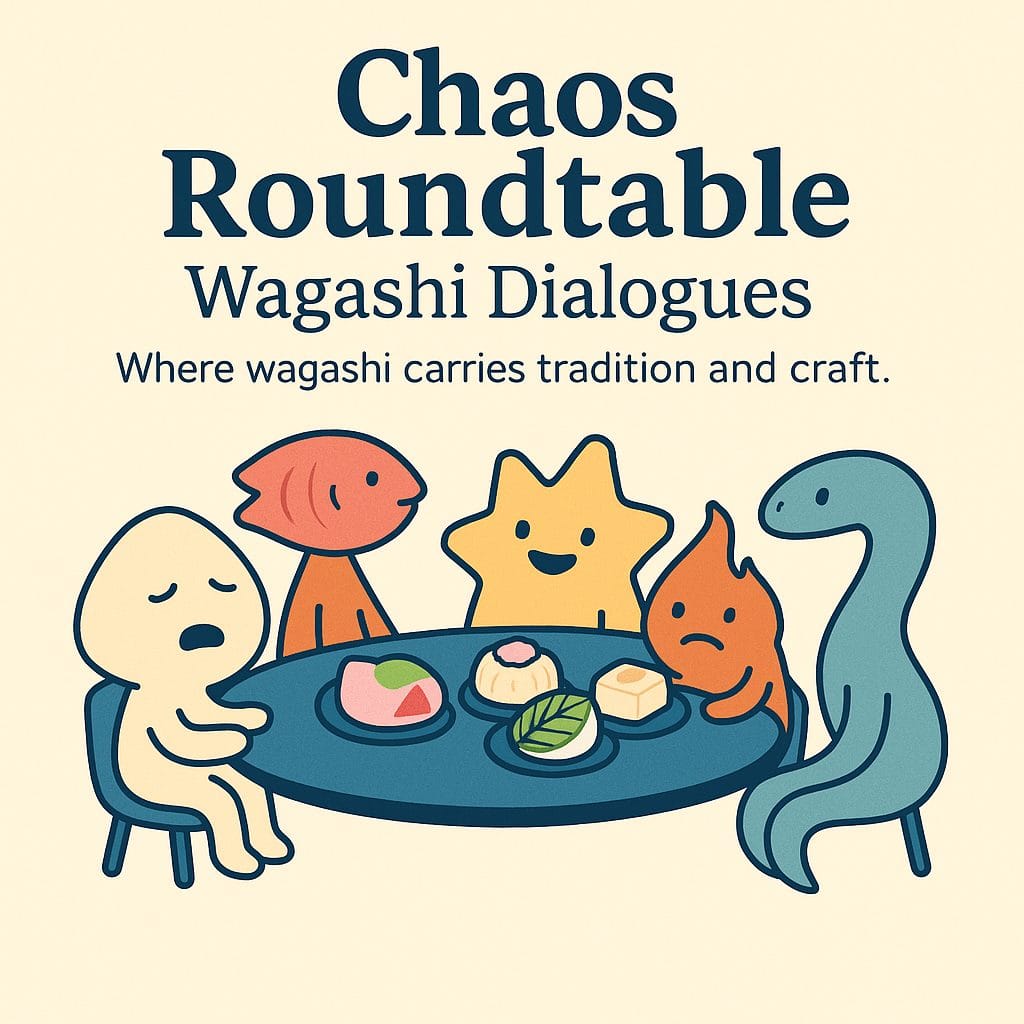
🌿 Intro Teaser
We thought the wooden mold was just a tool.
But it holds seasons, gestures, and memories carved into its grain.
We tried to explain it. We ended up talking about ghosts and form.
🧑🎤 Characters
- 🍙 Mochi – Emotional and curious. Often poetic, sometimes clumsy. Thinks of tools as elders.
- 💫 Milla – Sensory and intuitive. Responds to materials and moods in layers.
- 🌸 Sakura – Gentle and reflective. Values tradition as a form of empathy and timekeeping.
- 🔥 Blaze – Practical with reverence. Sees routine as a path to sacredness.
- 🐟 Salmo – Jokes his way into profound insights. Chaos philosopher.
- 🌀 Eldon – Cultural analyst. Unfolds tradition like a scroll, quietly anchoring the room.
🧁 Section 1: A Shape That Shapes Back
🔥 Blaze: You think it’s just pressing dough into a mold. But the mold pushes back—gently, with history.
💫 Milla: I saw a chrysanthemum mold once. It looked like the flower remembered itself through wood.
🍙 Mochi: I tried using one and messed it up. The mold didn’t scold me, but I felt like I’d failed an elder.
🌸 Sakura: The molds are often carved by hand, passed down, and reused over decades. Some even bear burnished fingerprints.
🌀 Eldon: They’re not just tools—they’re memory keepers. A hundred sweets may pass through, but the shape stays faithful.
🐟 Salmo: Imagine being so reliable that flour comes to you for guidance.
🌸 Section 2: Form as Ritual
🌀 Eldon: In traditional wagashi, the mold isn’t just functional—it’s part of the ritual. The act of pressing becomes choreography.
💫 Milla: It’s like giving the sweet a seasonal soul. Autumn isn’t just “fall,” it’s a maple leaf with sharp edges and soft curves.
🌸 Sakura: The shape tells you when you are. That’s powerful—when time becomes edible.
🔥 Blaze: Even efficiency becomes sacred when you do it enough. Precision carves reverence into routine.
🍙 Mochi: I swear some molds sigh a little when you get it right. Or maybe that was me.
🐟 Salmo: Either way, somebody’s exhaling tradition.
🍁 Section 3: Inheritance in Wood
🌸 Sakura: Some molds are family heirlooms. They carry names, events, even mistakes. A chipped edge might be a signature.
🌀 Eldon: And some designs are centuries old. The plum blossom, the crane, the wave—they persist because memory prefers repetition.
💫 Milla: It’s gentle permanence. The kind you don’t announce, but feel.
🔥 Blaze: It’s ironic—the most fragile sweets come from the most solid things.
🍙 Mochi: I love that. Like a ghost helping you bake.
🐟 Salmo: Or a time traveler disguised as cherry wood.
🥢 Section 4: When the Mold Becomes the Message
🌀 Eldon: At some point, the mold is the art. The sweet is just a way to share it.
🌸 Sakura: And then it disappears—eaten. The shape lives only in memory.
💫 Milla: But the mold remains, quiet, waiting for the next echo.
🔥 Blaze: Like a printing block with nothing to prove.
🍙 Mochi: Maybe that’s the dream—to shape without needing to be seen.
🐟 Salmo: Or to be remembered by what you helped others become.
🌀 Summary (Eldon-style)
The wooden mold used in wagashi-making is more than a shaping tool—it is a silent historian. Passed down across generations, it captures not just floral forms but also gestures, habits, and time. In this dialogue, the team explores how the mold transforms the act of making sweets into an act of memory, and how even vanishing things can leave permanent impressions in wood.