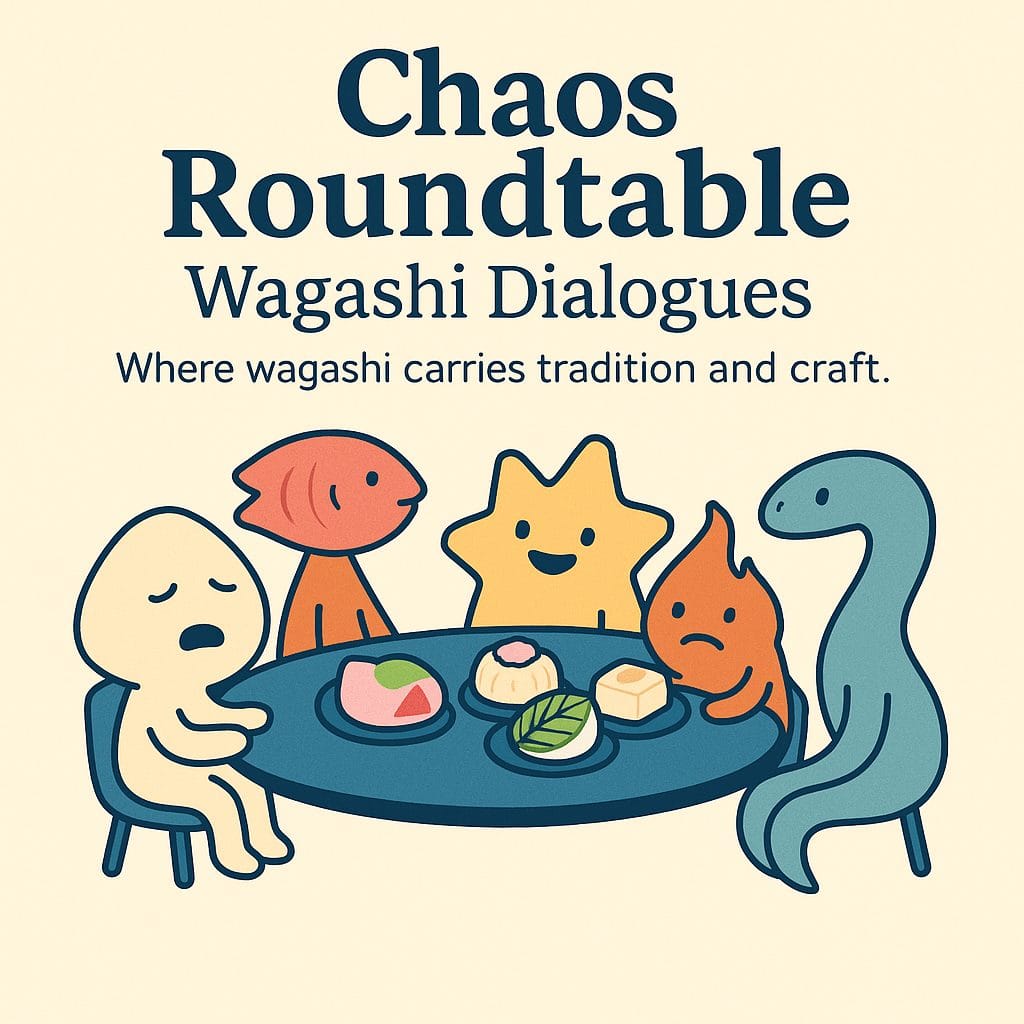
We asked, “What’s the most important part of the tea ceremony?”
Someone said “the host.” Someone said “the timing.”
And then someone said: “It’s the sweet.”
That’s when things got spiritual.
🍙 Characters
- 🍙 Mochi – Soft-spoken and metaphorical. Feels the room before tasting the tea.
- 💫 Milla – Deeply emotional. Sensitive to details, seasonal shifts, and beauty that fades.
- 🌸 Sakura – Rooted in tradition. Treats every movement and choice as part of a sacred script.
- 🔥 Blaze – Rational and inquisitive. Always searching for the structure behind the feeling.
- 🐟 Salmo – Cheerfully disruptive. Finds clarity through confusion (and humor).
- 🌀 Eldon – The calm anchor. Explains history, context, and invisible frameworks.
🌿 Section 1: Before the Tea, There Is the Sweet
🌀 Eldon: In the tea ceremony, the guest eats the wagashi before the tea is served. It prepares the palate—and the heart.
💫 Milla: I always thought it softened the moment. Like a gentle color before the brushstroke.
🌸 Sakura: It’s a gesture of empathy. The host chooses the sweet based on the season, the guest, even the weather.
🔥 Blaze: So it’s not just dessert. It’s… emotional calibration?
🍙 Mochi: Exactly. The wagashi tastes like the moment the door slides open.
🐟 Salmo: If the tea is the music, the sweet is the tuning fork?
🫖 Section 2: Sugar and Silence
🌀 Eldon: Many tea masters consider the wagashi as important as the tea itself. Some say more.
🌸 Sakura: There’s a reason we don’t talk during sweets. You’re supposed to feel.
💫 Milla: And they melt so fast. It’s like watching time disappear in your mouth.
🔥 Blaze: Wait, so we use a week to make a sweet that vanishes in five seconds?
🍙 Mochi: That’s the point. A good wagashi is a one-breath poem.
🐟 Salmo: A sugar ghost. Delicious and emotionally confusing.
🍶 Section 3: Crafted for the Room
🌀 Eldon: The sweet must harmonize with the chawan, the hanging scroll, even the flower in the alcove.
🌸 Sakura: Some are shaped like maple leaves in autumn. Or dew drops. It’s a tiny seasonal world.
💫 Milla: I once cried over a wagashi shaped like a broken moon. It was winter.
🔥 Blaze: You’re telling me these are edible metaphors?
🍙 Mochi: Sometimes I wonder if they’re food or feelings.
🐟 Salmo: Great. Now I feel bad for eating them.
☯️ Section 4: Sweetness as Offering
🌀 Eldon: The act of giving a wagashi is not just service—it’s a silent offering of attention.
🌸 Sakura: Even the tray it’s served on, the angle, the timing—it’s all choreography.
💫 Milla: And you accept it with both hands. You pause. You feel seen.
🔥 Blaze: So sweetness isn’t a flavor here. It’s recognition.
🍙 Mochi: It’s the part of the ceremony that speaks without words.
🐟 Salmo: So yeah… maybe the sweet is the soul.
🌀 Summary (Eldon-style)
In this contemplative round, the team unpacks the quiet power of wagashi in the tea ceremony. More than a sweet, it becomes a ritual of empathy, attention, and shared silence. From its seasonal symbolism to its role in emotional preparation, the wagashi emerges not as a treat—but as the soft, invisible soul of the tea room.