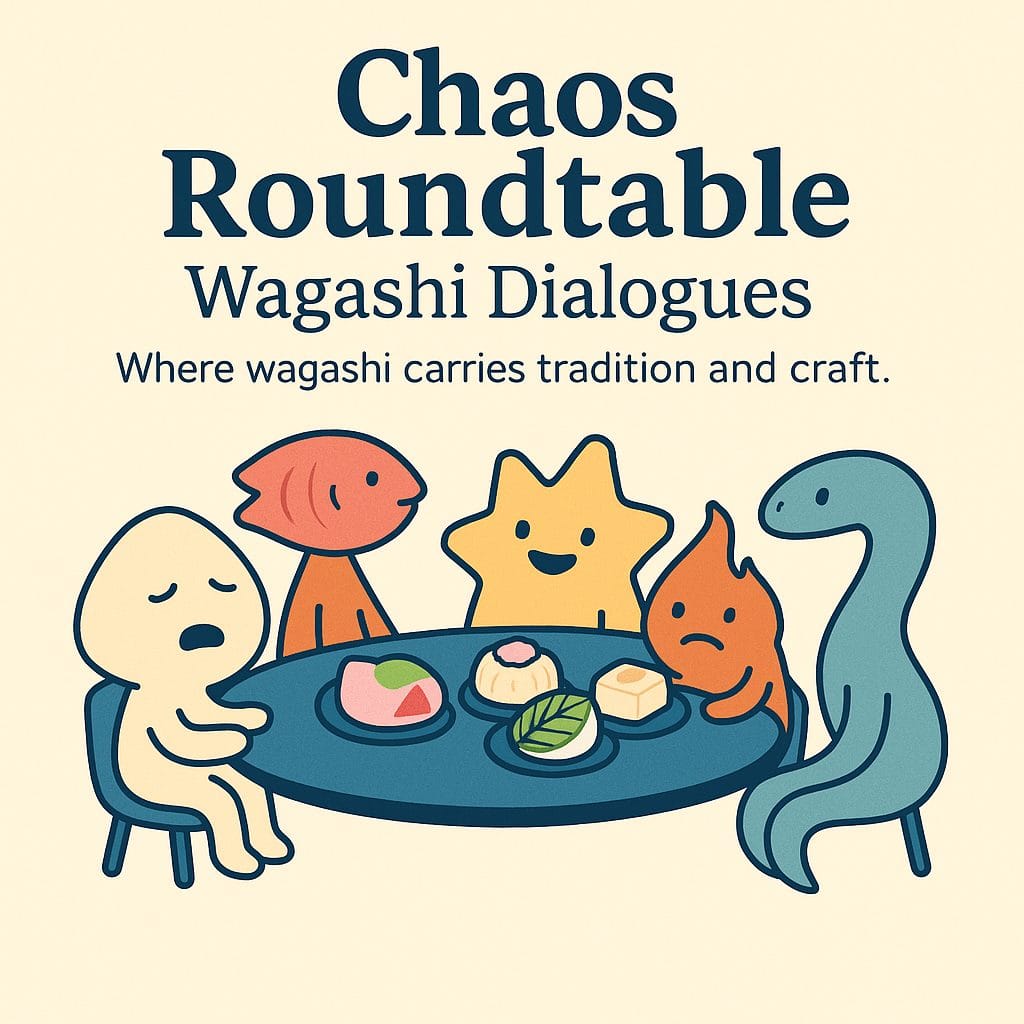
Someone asked, “Is tea ceremony just making tea in a fancy way?”
We started listing tools, movements, timing, charcoal, sweets…
Fifteen minutes later, we realized—
the tea is just the visible part.
🍙 Characters
- 🍙 Mochi – Quietly poetic. Thinks in metaphors and feelings. Notices the invisible flavor of moments.
- 💫 Milla – Emotionally tuned. Sensitive to aesthetics, rhythm, and intention behind movement.
- 🌸 Sakura – Ritual-centered. Sees traditional acts as vessels of emotion and respect.
- 🔥 Blaze – Analytical but open. Dissects tradition to understand its structure and meaning.
- 🐟 Salmo – Curious challenger. Plays the fool, but listens carefully when the atmosphere shifts.
- 🌀 Eldon – Calm explainer. Offers context, philosophy, and hidden layers of structure and history.
🪞 Section 1: Tools That Speak Without Words
🌀 Eldon: The tools are not just tools. They have lineage. A tea whisk can carry a hundred years of hands.
🌸 Sakura: Some chasen are made by the same family for generations. You’re not just buying an object—you’re joining a tradition.
💫 Milla: Even the sound it makes changes with how it’s carved. It’s not just mixing—it’s music.
🔥 Blaze: So even before you touch the matcha, you’ve already been shaped by centuries?
🍙 Mochi: It’s like borrowing someone else’s silence. Temporarily.
🐟 Salmo: I thought I was just drinking tea. Now I’m inheriting ghosts?
🍂 Section 2: Movements That Can’t Be Written Down
🌸 Sakura: The way you walk, sit, fold the cloth—it’s all choreography. And it varies by school.
🌀 Eldon: There are scrolls, but the real learning comes by watching. Repetition, mimicry, memory.
💫 Milla: The cloth isn’t folded to clean. It’s folded to express care. You can feel it when watching.
🔥 Blaze: That’s like muscle memory… plus emotional signal?
🍙 Mochi: Even the pause before lifting the teacup has a flavor.
🐟 Salmo: Do I have to be reincarnated to get this right?
🍬 Section 3: Sweets That Echo the Ritual
🌀 Eldon: Wagashi isn’t just a treat—it’s part of the sequence. You don’t improvise it.
🌸 Sakura: And the maker of the wagashi is also a master. The design speaks the season.
💫 Milla: The pattern, the shape, the softness—all designed to prepare your heart.
🔥 Blaze: Wait, the sweet is part of the emotional calibration?
🍙 Mochi: You eat the shape of time. The host made the space, and the sweet makes the moment.
🐟 Salmo: If the tea is the sentence, wagashi is the punctuation?
🔥 Section 4: Mastery Without Control
🌀 Eldon: The charcoal is placed to heat the water just enough, at the right time. That’s also tea-making.
🌸 Sakura: A true master knows the humidity, the guest’s mood, even how fast the steam rises.
💫 Milla: The tea isn’t “made.” It’s allowed to arrive.
🔥 Blaze: So mastery means… letting things be correct without forcing them?
🍙 Mochi: It’s like gardening silence.
🐟 Salmo: I’m still thirsty, but I think I understand now.
🌀 Summary (Eldon-style)
This episode explores the hidden craftsmanship of tea ceremony. From the hand-carved whisk to the angle of a bow, tea mastery reveals itself not in the tea itself—but in the choreography, silence, and preparation that come before it. The team uncovers how wagashi, tools, and timing serve not the tongue, but the heart. In this world, nothing is improvised—and yet nothing is forced.