They boil agar and sugar.
They pour it, then wait.
For days. For sparkle. For silence.
We tried to describe kingyokutō.
Instead, we debated whether patience can become flavor.
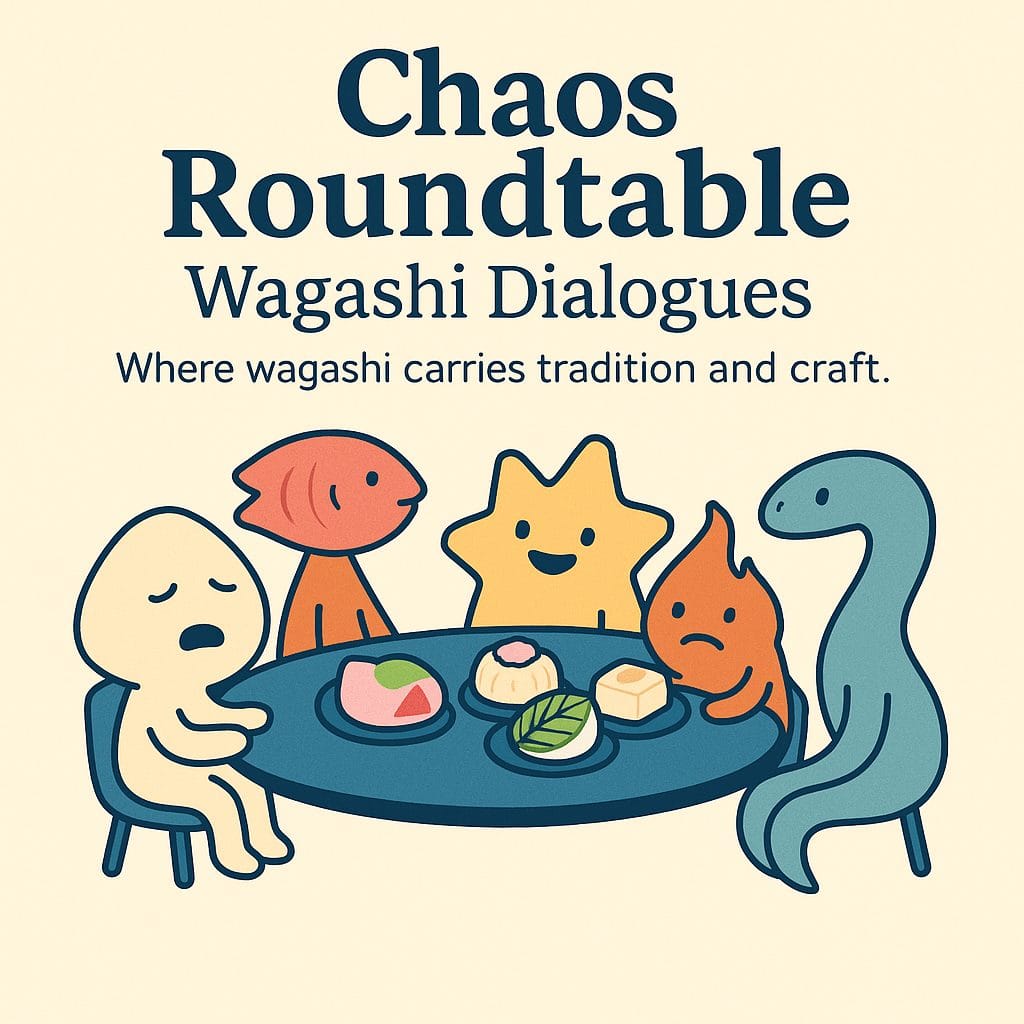
🍙 Characters
- 🍙 Mochi – Gentle disruptor. Speaks in soft, poetic metaphors. Sees sweets as living metaphors for time and memory.
- 💫 Milla – Intuitive and sensory. Notices texture, rhythm, and emotional undercurrents in everything.
- 🌸 Sakura – Seasonal and reflective. Connects sweets to heritage, family, and quiet emotion.
- 🔥 Blaze – Precise and pragmatic. Values the technique, logistics, and cultural systems behind tradition.
- 🐟 Salmo – Curious realist. Asks skeptical questions but enjoys being surprised.
- 🌀 Eldon – Calm historian. Provides cultural, technical, and structural context with clarity.
🧪 Section 1: Sugar, Agar, and… Stillness?
🍙 Mochi: So you’re telling me kingyokutō is basically jelly that decided to become glass?
🌀 Eldon: Not glass—crystal. It’s made from boiled kanten and sugar. But it’s not finished when you pour it.
🔥 Blaze: The key is drying. Air-drying for days or even a week. That’s when the outer layer slowly crystallizes.
🌸 Sakura: But you can’t just leave it anywhere. Humidity, temperature, air flow—all matter. The candy listens to the room.
💫 Milla: So the environment becomes part of the recipe. That’s… poetic.
🐟 Salmo: Wait. So they just let it sit around and sparkle happens?
🌀 Eldon: Controlled neglect, Salmo. Like bonsai, but edible.
⌛ Section 2: Drying Sugar, Holding Form
🔥 Blaze: Traditional artisans make molds from wood or silicone, pour the hot mix carefully, and time the drying precisely.
🌸 Sakura: And they dry them individually, spaced out. Otherwise, moisture clings and ruins the surface.
💫 Milla: That explains why some pieces have that frost-like shimmer… it’s not decoration. It’s sugar becoming time.
🌀 Eldon: It’s a transition state—solid, but not stiff. Like holding a breath just before exhaling.
🍙 Mochi: I love that it becomes more beautiful after it’s been made. Like it grows on silence.
🐟 Salmo: So no fridge, no shortcuts?
🔥 Blaze: No. If you rush it, it clouds. The crystal doesn’t form. Some makers even flip pieces during drying to balance airflow.
💠 Section 3: Skills You Can’t Write Down
🌀 Eldon: There’s no fixed drying time. It depends on the weather. Masters adjust by touch, by sight.
🌸 Sakura: My grandmother used to say, “If you can hear the dryness, it’s ready.”
💫 Milla: That’s a kind of intuition. Not just technique—it’s trust in experience.
🔥 Blaze: In a factory setting, you’d automate everything. But then you lose the moment-to-moment judgment that creates uniqueness.
🐟 Salmo: So this isn’t a recipe. It’s a conversation—with sugar, air, and time.
🍙 Mochi: Kingyokutō is the only sweet that gets dressed after the curtain falls.
✨ Section 4: Eating the Delay
💫 Milla: When you bite it, the outside cracks like frost. The inside melts like memory.
🌸 Sakura: It’s one of the few sweets that’s more about feel than flavor.
🌀 Eldon: The contrast is intentional—rigid vs tender, dry vs yielding. A sensory poem.
🔥 Blaze: You’re not just eating sugar. You’re eating silence, process, restraint.
🐟 Salmo: And then it’s gone. That long process—crunched in two seconds.
🍙 Mochi: But that’s why it’s worth it. It disappears like it was never yours… except it was.
🌀 Summary (Eldon-style)
This session explores the artisanal techniques behind kingyokutō, a translucent Japanese sweet made from agar and sugar. Unlike typical confections, it requires days of careful air drying to form its crystalline shell—an art that varies with weather, air flow, and intuition. The group discusses how patience, craft, and silence become ingredients, making kingyokutō not just a treat but a sensory expression of time itself.