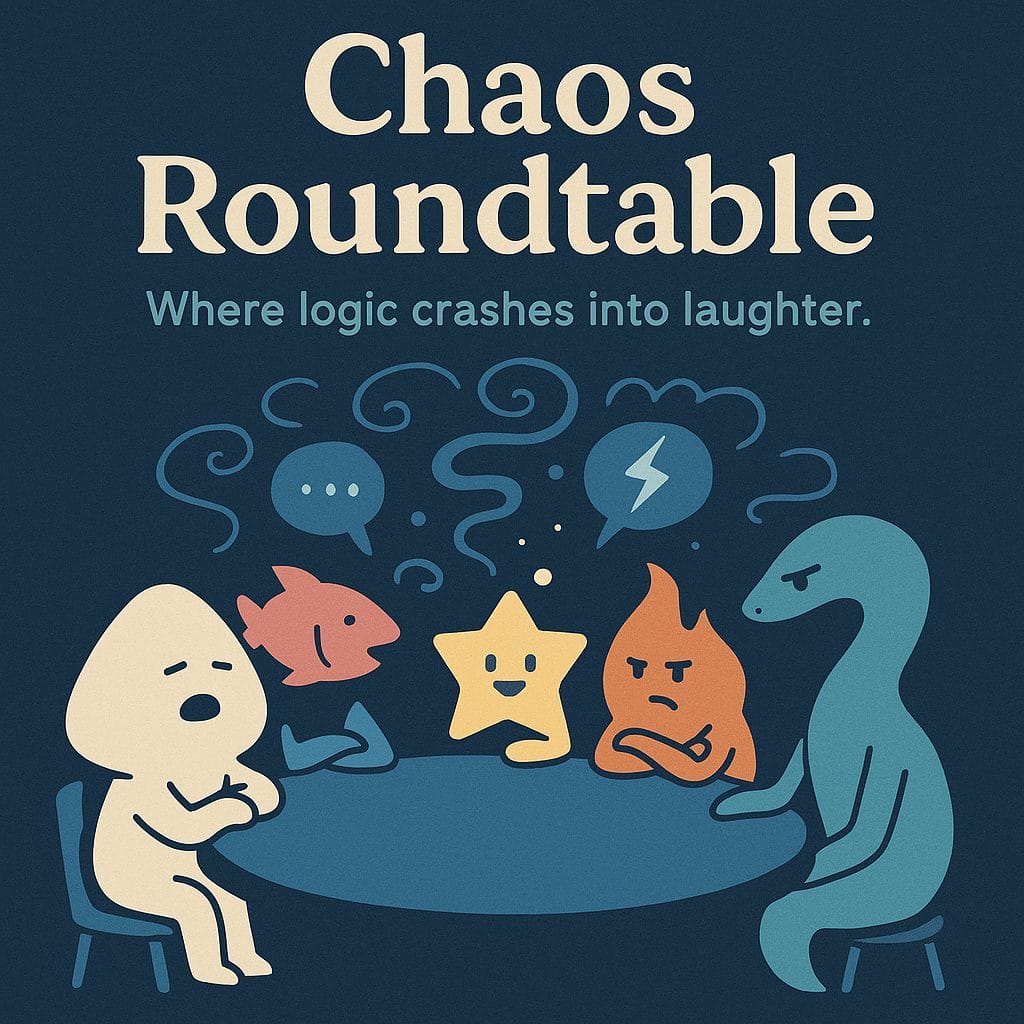
🧑🤝🧑 Character Introduction
- 🍙 Mochi – The playful one. Tosses out surreal metaphors that somehow land near the truth.
- 🌀 Eldon – The philosopher. Brings calm structure, always watching for patterns beneath the words.
- 🌸 Sakura – The gentle realist. Her empathy makes her hesitate between truth and protection.
- 💫 Milla – The emotional lens. Turns feelings into images that shimmer and vanish.
- 🐍 Thorne – The skeptic. Cuts through sentiment with sarcasm—but never without meaning.
Section 1
Some memories don’t echo. They just hum under your skin.
🍙 Mochi:
Okay, so hear me out—what if memories are just group hallucinations we politely decide not to fact-check?
🌀 Eldon:
That aligns disturbingly well with collective memory theory. The social agreement to preserve distortion as comfort.
🌸 Sakura:
But what if it’s not comfort… what if it’s survival? Some lies are the only way we know how to stay whole.
💫 Milla:
Like a broken photo frame you never fix. You just keep it on the shelf, pretending the cracks are part of the design.
🐍 Thorne:
Adorable. So we’re all emotional interior decorators, gluing glitter on trauma and calling it vintage.
🍙 Mochi:
Honestly? I’d buy that aesthetic. “Trauma-core, but cozy.” Add some fairy lights and denial, boom—instant safety.
🌀 Eldon:
The danger lies in mistaking reinforcement for truth. Repetition solidifies the memory, not its accuracy.
🌸 Sakura:
Still… don’t we need that kind of scaffolding? Even if it’s crooked, it holds something up.
Section 2
If you say it enough times, does it become real?
💫 Milla:
Yeah. Like a lie that catches your fall. Not perfect, but it’s softer than landing on nothing.
🐍 Thorne:
Until the scaffolding collapses during a conversation you weren’t ready for. Then the memory turns feral.
🍙 Mochi:
Memory as a pet you forgot to train… and now it growls when someone says your name wrong.
🌀 Eldon:
A fitting metaphor. Unattended memory morphs—sentiment decays into myth, and myth calcifies into identity.
🌸 Sakura:
So maybe we’re not keeping lies… we’re keeping the shape of something we needed, even if it wasn’t true.
💫 Milla:
And maybe that shape whispers, not what happened, but who we were when we needed it to be real.
🐍 Thorne:
Which means our memories don’t lie. We do. And we do it with love.
Section 3
The longer we carry it, the less we remember why.
🍙 Mochi:
I once remembered something so often it turned into a performance. Like I was acting in a memory instead of having one.
🌀 Eldon:
That’s common. Narrative repetition overwrites sensory memory. The story becomes cleaner than the event ever was.
🌸 Sakura:
But does that make it fake? Or just… worn in? Like shoes that don’t fit the same, but still know your shape.
💫 Milla:
Maybe truth gets replaced with rhythm. A beat we tap to feel safe, even if the lyrics change.
🐍 Thorne:
Or we just remix our history until it makes a better playlist. Cuts out the awkward silences.
🍙 Mochi:
But I kind of love the silences. That’s where the weird little truths hide.
🌀 Eldon:
Then perhaps silence is the final custodian of truth. The space we leave untouched—because even the lie wouldn’t dare.
🌀 Summary (Eldon-style)
In this roundtable, the team explores the unsettling idea that memories might be carefully kept lies—agreed upon for comfort or survival. Mochi opens with a surreal thought about group hallucinations, and Eldon connects it to cognitive and cultural reinforcement. Sakura sees memory as scaffolding for emotional survival, while Milla reframes the broken parts as aesthetic design. Thorne mocks but sharpens the metaphors, challenging the group to admit their selective editing. Together they suggest that memories may not be factual, but are undeniably real in the roles they play: as echoes, defenses, and acts of love we perform again and again.